Choosing the Best AI Visibility Tool
The best AI visibility tool depends on budget and whether you want to own the code. Profound, Otterly, Geoptie, and PromptRank compared, with an honest verdict.
The best AI visibility tool in 2026 is Profound if you're an enterprise brand team with roughly $1,000 a month and no appetite for infrastructure, Otterly.ai if you're a PR team that mainly needs alerting, and PromptRank if you want to own the platform outright rather than rent a seat forever. There is no single winner, because these tools are solving the same measurement problem for very different buyers.
We build one of them, so read the rest of this with that in mind. We've tried to be useful about the alternatives first, because a comparison where the author's product wins every row isn't a comparison.
Here's the part that decides most of these purchases, and it isn't features. It's whether this is a line item you'll still be paying in three years, or a thing you buy once. Everything else follows from that.
Key Takeaways
- Profound is the strongest enterprise option at around $1,000 a month, and genuinely worth it at that scale.
- Otterly.ai wins on alerting for PR and comms teams who need to know within hours, not weekly.
- Geoptie is the lightest option and suits agencies producing client audits rather than continuous tracking.
- PromptRank is $99 once, or $499 with resale rights, self-hosted, and you get the source code.
- The four features that actually differentiate: engine coverage, whether queries are grounded in live search, scheduling, and citation extraction.
What Separates These Tools
Every product in this category shows you a percentage on a dashboard. Four things underneath that percentage decide whether it means anything.
Engine coverage. ChatGPT alone is not the channel. Claude, Gemini, Perplexity, and Grok all answer differently, and the one that matters is whichever your buyers use. A tool covering one engine is measuring a fifth of the problem.
Grounding. This is the big one and almost nobody asks about it. Does the tool fetch live search results before asking the model, or does it just ask the model? Ungrounded queries measure training data, which is months stale and invents citations that don't exist. Grounded queries measure what a real user sees today.
Scheduling. Model answers drift. A tool that runs on demand gives you a photograph; a tool that runs on a cycle gives you a trend. Only the trend is actionable.
Citation extraction. Knowing you were mentioned is worth something. Knowing which four domains the model read to decide that is worth ten times more, because those domains are where the work is.
If a vendor demo won't show you those four, the percentage on the dashboard is decoration. The original GEO research from Princeton found structural page changes, citations, quotations, and statistics, lifted visibility in generated answers by up to 40%, and you can only act on that finding if you know which pages the models are reading in the first place.
Want to check those four on ours before reading the comparison? The PromptRank demo is open and you can run a real prompt through it.
The Four Options Worth Considering
| Profound | Otterly.ai | Geoptie | PromptRank | |
|---|---|---|---|---|
| Best for | Enterprise brand teams | PR and comms | Agency audits | Owning the platform |
| Pricing model | ~$1,000/mo | Subscription | Subscription | $99 once, $499 with resale |
| Hosting | Hosted | Hosted | Hosted | Your own server |
| Source code | No | No | No | Yes |
| Strongest at | Share-of-voice reporting at scale | Mention alerting | Fast audit reports | Citation and sentiment depth |
| Weakest at | Price, and a closed algorithm | Passage-level analysis | Technical depth on indexation | You have to run a server |
Four honest paragraphs, one each.
Profound is the enterprise standard and deserves the position. If you're a brand director with a real budget who needs share-of-voice reporting that a CMO will accept without explanation, it does that better than anything else and it does it at scale. The two limits are the price, which rules it out for most mid-market teams, and the closed methodology: you get the number, not the derivation, and there's no simple developer API to pull it into your own reporting.
Otterly.ai is the one we recommend most often to people who aren't buying from us. If your actual need is "tell me within a few hours when an AI answer starts describing us badly," that's alerting, not analytics, and Otterly is built for it. Where it stops is passage-level depth: it will tell you sentiment shifted, and it's thinner on the structural recommendations that would tell you what to do about it.
Geoptie handles GEO auditing for agencies that need to produce a client-facing report quickly. It's the lightest of the four and priced accordingly. The dashboards are generic, and if your clients ask technical questions about prompt-level optimization or how model indexation actually works, you'll be answering those yourself.
PromptRank is ours. It runs each prompt across ChatGPT, Claude, Gemini, Grok, and Perplexity through OpenRouter, grounds every query in live search results before the model call, extracts the exact sentences where a brand is named, tracks the domains cited, scores sentiment, and syncs with Google Search Console so your prompt list comes from queries you already convert on. You license it once and run it yourself. That's the pitch and also the catch, which we'll get to.
Where Each One Fits
Match the tool to the situation rather than the feature list.
You're a brand team at a large company. Profound. Your constraint is credibility with executives and coverage across a wide category, not cost per seat, and it's built for exactly that. Don't make an engineering decision out of a reporting problem.
You're in PR or communications. Otterly.ai. What you need is to know quickly when the narrative moves, and a weekly analytics cycle is the wrong shape for that job.
You're an agency selling audits. Geoptie if the deliverable is a report and the engagement is short. PromptRank if you want to run continuous tracking for many clients under your own brand, because the $499 resale licence removes the per-client seat cost entirely.
You're a founder or a small marketing team. This is where the money question bites. A $1,000 monthly subscription is $36,000 over three years. A $499 licence and a $24 server is about $1,400 over the same period. If your category has thirty relevant prompts rather than three hundred, the hosted premium is buying you convenience, not capability.
You want it inside your own systems. Then you want the source code, and only one of these four gives it to you.
Our Pick and Why
Ours, obviously, and here's the reasoning you can check rather than the claim.
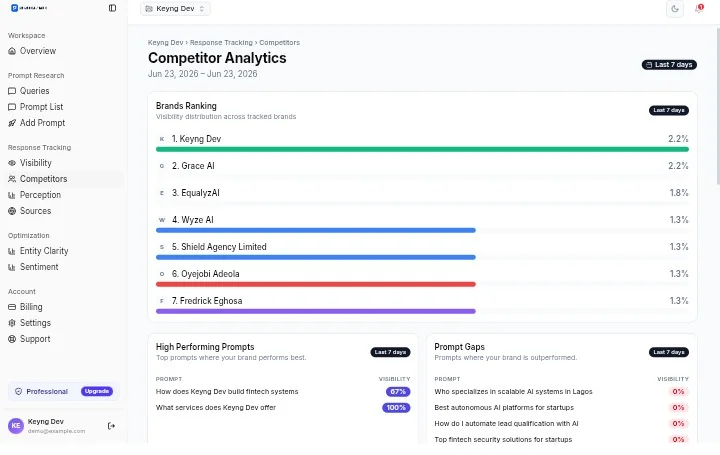
The measurement depth is real and specific. Competitor tracking identifies prompt gaps, the queries where a rival was recommended and you weren't, which is the single most useful screen in the product:
Sentiment goes past a positive-or-negative score to the attributes models attach to your name, sorted and categorised:
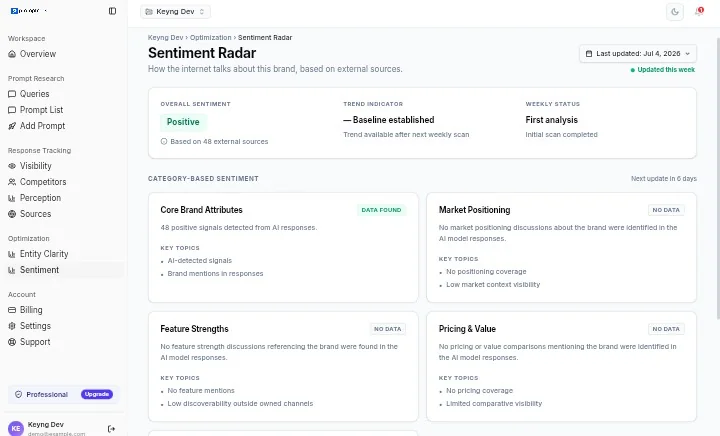
"Expensive" attached to your brand across forty answers is a positioning problem you'd never find in a share-of-voice percentage. That's the kind of thing this category should be surfacing and mostly doesn't.
Underneath, prompts run through queue-backed background workers rather than blocking a web request, each one grounded in live search first, fanned out across all five engines, with a scheduled job re-running stale prompts automatically so the trendline builds without anyone remembering to click something.
And an agency we work with runs it for eleven clients under their own branding on one $499 licence. At Profound's pricing that same coverage would be an $11,000 monthly problem. That's not a knock on Profound, whose product is aimed at a different buyer entirely. It's arithmetic that matters enormously if you're the second kind of buyer.
Ready to compare it against your current tool? Run the demo side by side with whatever you're using and check the citation depth.
What You Actually Own
This is the differentiator, and it's worth being precise about what it does and doesn't mean.
You get the full application: frontend, backend, database schema, admin panel, installer. It runs on your server, under your domain, with your logo.
You set the subscription tiers if you're reselling. You keep the data. Nobody can reprice you, sunset the product, or change the terms.
Owning your source code gives you flexibility, full stop. It's security, because you decide who touches it. It's freedom, because any developer can change anything.
And it's an asset, because if you ever sell the business, the code is part of what a buyer is buying. Nobody buys what they can't see.
What ownership doesn't mean: you can't resell the source files, on any licence. You're running a service, not redistributing a codebase.
Now the honest cost of that. It needs a Linux VPS, because background workers and scheduled jobs don't survive on shared hosting or serverless. You fund the API balances yourself, OpenRouter for the models and Serper for the search grounding, which is cheaper than a hosted markup but is a bill you now watch. And when something breaks at 2am, it's yours.
If none of that appeals, buy the subscription. Genuinely. The convenience premium on a hosted tool is real value for a team without an engineer, and pretending otherwise would be dishonest.
If you'd rather have it built into your stack, our custom development services cover integration work from a $500 base, and installation is a flat $150 if the server is the only thing standing in your way.
Doing It Manually First
Worth saying, because it costs nothing.
Before you buy any of these, take your ten most important buying questions and run them through ChatGPT, Gemini, and Perplexity by hand. Write down whether you were mentioned and who was mentioned instead. That's an afternoon, and it tells you whether this channel matters enough for you to fund it.
Where the manual approach falls apart is repetition. You cannot compare this week to last week reliably, you'll unconsciously phrase prompts in your own favour, and thirty prompts across five engines is 150 answers per cycle, which is a job, not a task. But as a way to decide whether to spend anything at all, it's the cheapest possible starting point and we'd rather you did it.
Google's own documentation, incidentally, says there are no special optimizations required to appear in AI Overviews beyond being indexable and being good. Any vendor promising you a technique rather than a measurement is worth a second look.
The Category in Context
If someone on your team still needs convincing this is a distinct channel rather than an SEO reporting upgrade:
Frequently Asked Questions
What is the best AI visibility tool?
It depends on your constraint. Profound for enterprise brand teams with budget, Otterly.ai for PR teams needing fast alerts, Geoptie for quick agency audits, and PromptRank if you want to own the platform rather than rent a seat. All four measure the same thing; they differ on depth, price, and whether you get the code.
How much do AI visibility tools cost?
Hosted tools run from roughly $99 to $1,000+ a month depending on tier and coverage. Self-hosted, PromptRank is $99 once for a single deployment or $499 with resale rights, plus $12 to $40 a month for a server.
Do these tools work with ChatGPT, Claude, and Gemini?
The better ones cover all the major engines. PromptRank runs each prompt across ChatGPT, Claude, Gemini, Grok, and Perplexity in the same cycle. Ask any vendor how many engines they query and whether the results are grounded in live search, because both answers vary a lot.
Can I track competitors as well as my own brand?
Yes, and it's the more useful half. Competitor tracking surfaces prompt gaps, meaning the questions where a rival gets recommended and you don't, which is a much clearer to-do list than your own visibility score.
How often should tracking run?
Weekly is a sensible floor. Model answers drift enough that a monthly cycle hides real movement, and daily is usually more noise than signal for anything but a live incident.
Is a free AI visibility tool good enough?
For deciding whether the channel matters, running prompts manually costs nothing and is a genuinely reasonable first step. For anything continuous, the limitation isn't the model access, it's the scheduling, storage, and comparison, which is what you're actually paying for.
Making the Call
Ask one question before you compare features: is this a subscription you're comfortable holding for three years, or a purchase?
If it's a subscription, pick on fit. Profound for enterprise reporting, Otterly for alerting, Geoptie for fast audits. All three are fine at what they're for, and we'd rather you bought the right one than the one we sell.
If it's a purchase, there's one option in this comparison and you can go and inspect it before spending anything. Open the PromptRank demo, create two accounts, run a prompt from your own category, and look at what it says about your citations. That's a better basis for choosing the best AI visibility tool than any table, including ours.
And if what you want is this capability wired into reporting you already run, tell us what you're measuring and we'll come back with a fixed price. The code is yours at the end, which is rather the point.