Custom Mobile Software Development
Custom mobile software development runs $12,000 to $45,000 over eight to sixteen weeks. How to choose native, cross-platform, or web, and what drives the quote.
Custom mobile software development typically runs $12,000 to $45,000 and takes eight to sixteen weeks, depending on whether you need one platform or two, and how much of your product lives on a server rather than on the phone. A cross-platform build covering iOS and Android sits at the lower end. Two separate native apps sit at the top.
If you're collecting quotes right now, those numbers are the ones you're trying to sanity-check. So let's start there rather than making you scroll.
Here's what most quotes won't tell you, though. The number is driven far more by how settled your requirements are than by which framework anyone picks. We've quoted the same feature list at $14,000 and at $38,000, and the difference was entirely how much of it the founder had actually decided.
Key Takeaways
- Cross-platform covers both stores for roughly $12,000 to $25,000 in eight to twelve weeks. Two native apps run $30,000 to $45,000 over twelve to sixteen.
- Choose native only when you genuinely need the hardware: continuous background location, heavy on-device processing, or platform-specific integrations.
- Most of what founders call a mobile app is a backend with a phone screen attached. That work is the same whichever route you pick.
- App Store review adds days to weeks and is outside anyone's control. Budget for it.
- You keep the source code, the repository, and the developer accounts. Always.
What a Mobile Build Involves
Less phone than you'd think.
A typical product splits into three parts. There's the app itself, the thing on the screen. There's the backend: accounts, data, payments, notifications, admin tools, the part that costs the most and that nobody demos. And there's the release machinery, the accounts and signing and store submissions that turn a working build into something a customer can install.
Founders arrive focused almost entirely on the first part. The quote is mostly about the second.
That's actually good news, because the backend is portable. If you start cross-platform and later need native, the server side comes with you untouched. The expensive half of the work is a decision you don't have to lock in on day one.
The release machinery is the part that surprises people. Developer accounts cost money annually, both stores have their own review, and Apple's review guidelines run to five categories of requirements your build has to satisfy before it reaches anyone. That's not development time, but it is calendar time, and it belongs on your launch plan.
Want a number for your specific build? Book a scoping call and you'll leave it with a written scope and a fixed price rather than a range.
Native, Cross-Platform, or Web
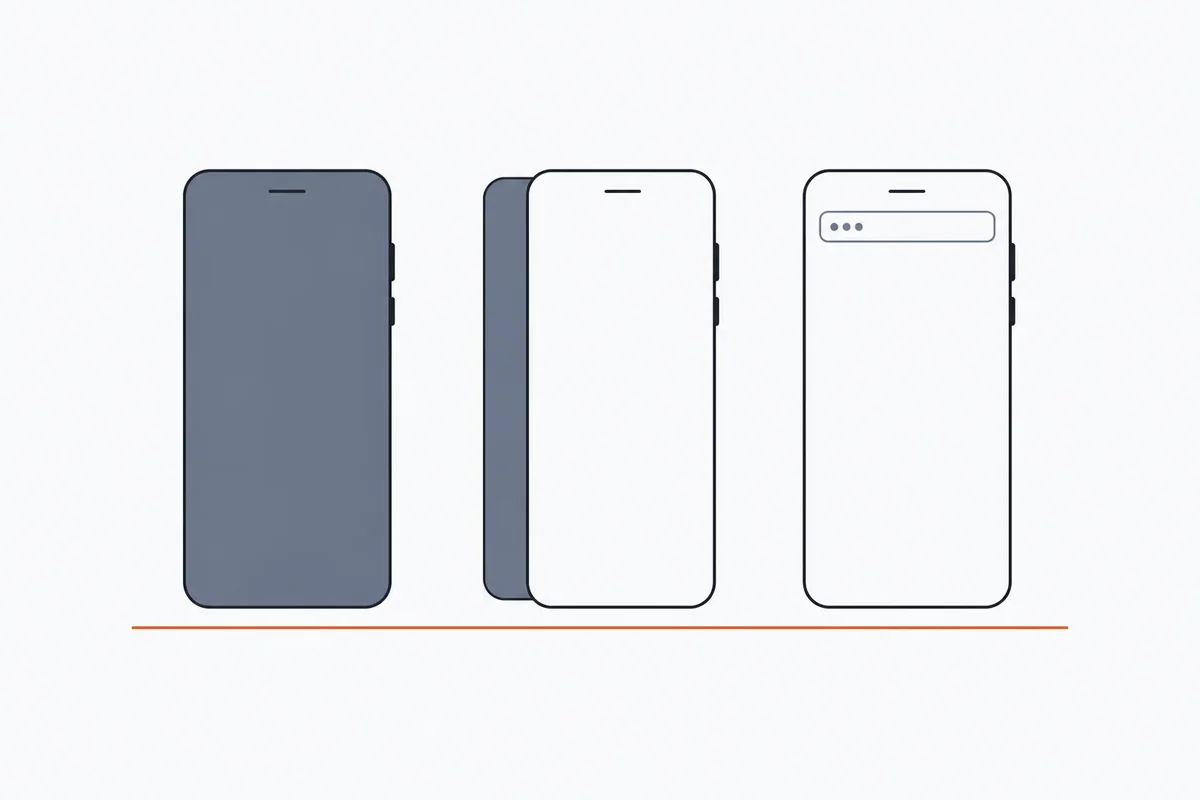
Three routes. The honest framework is a question about hardware, not a preference about tooling.
| Cross-platform | Native | Mobile web | |
|---|---|---|---|
| Covers | iOS and Android from one codebase | One codebase per platform | Any device with a browser |
| Typical cost | $12,000 to $25,000 | $30,000 to $45,000 for both | $8,000 to $18,000 |
| Typical timeline | 8 to 12 weeks | 12 to 16 weeks | 4 to 8 weeks |
| In the app stores | Yes | Yes | No |
| Push notifications | Yes | Yes | Limited |
| Deep hardware access | Most of it | All of it | Very little |
| Ongoing maintenance | One codebase | Two codebases, forever | One codebase |
Now the decision rule, which is shorter than the table.
Go native when the hardware is the product. Continuous background location, serious on-device processing, tight camera or sensor work, platform-specific integrations like CarPlay or widgets. If your product's core value depends on something the phone does rather than something your server does, pay for native and don't negotiate on it.
Go cross-platform for almost everything else. Marketplaces, booking, dashboards, social, fintech front ends, internal tools. The frameworks are mature, the performance gap closed years ago for interface-driven apps, and one codebase means one maintenance bill instead of two forever.
Go mobile web when you're testing whether anyone wants this. No store review, no download friction, ship in half the time. You lose push notifications and app store presence, which matters enormously for consumer products and barely at all for a B2B tool your users log into at work.
The honest version of the trade-off: cross-platform saves you roughly half the build cost and most of the ongoing maintenance, and costs you a small amount of polish that only a minority of products actually need. We recommend it most of the time, and we'll tell you plainly when your product is in the minority that shouldn't have it.
What It Costs and When
The ranges above are real, but they're ranges for a reason. Four things move a quote.
How settled the requirements are. The biggest variable by a wide margin. A founder arriving with a decided first release gets a build at the bottom of the band. A founder still deciding gets the top, because unresolved decisions become rework.
How much backend there is. Payments, multi-user accounts, real-time features, admin tooling, and third-party integrations each add real work. Two apps with identical screens can differ by $15,000 on what's behind them.
Whether it's one platform or two. Launching iOS only and adding Android later is a genuinely reasonable way to halve your first invoice, and cross-platform makes the second launch cheap.
Design. Working from an existing design system is fast. Designing from nothing adds two to three weeks before anyone writes code.
Here's how a first release actually runs:
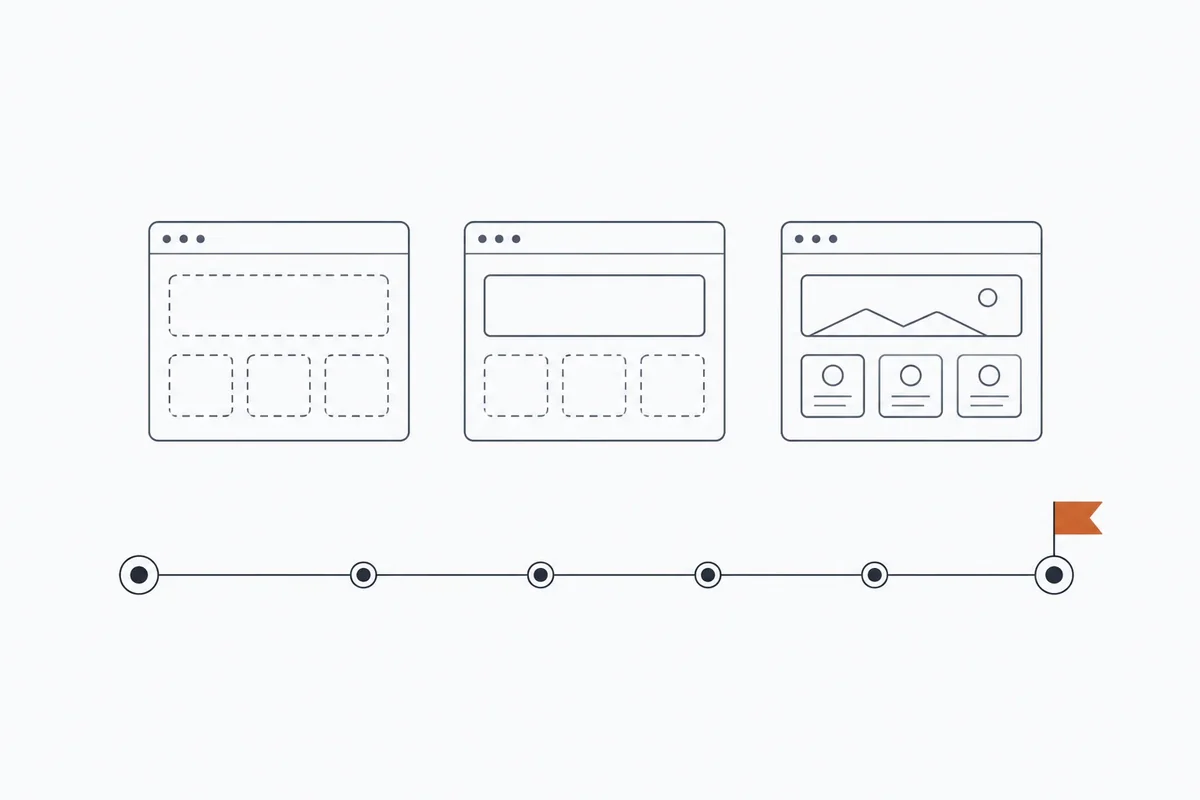
Scope and design first, then the backend and the app built together, then store submission, which is where the calendar stops being ours. We quote a fixed price against a fixed scope, and if we've underestimated, that's ours to absorb rather than a change order in week ten.
What we won't do is bill hourly and let the meter run. If your requirements genuinely change mid-build, the price changes, we tell you before we do anything, and you decide.
What We've Built for Clients
Claims are cheap, so here's the work.
Keyng Koin is a Telegram mini app on the TON blockchain, built to survive past 100k concurrent taps without the database seizing up, using Redis caching and queue workers to absorb write pressure that would flatten a normal setup. It's live, and you can open it on your phone right now.
That project is the clearest illustration of the point above: almost all the difficulty was server-side. The interface is simple. Holding a hundred thousand people tapping at once is not.
We've also shipped a fintech platform that processed 14,000 reconciliation events in its first month with zero queue failures, and rebuilt a logistics client's rendering path so page loads went from 4.2 seconds to 380 milliseconds. Across the portfolio that's 20+ products shipped and over $2M in client revenue generated.
None of that came easily. Our founder spent three years building every single day, and our early marketplace submissions were rejected repeatedly before the first approval came through. Each rejection sent us back to fix the unglamorous parts: authentication, rate limiting, input sanitisation. No shortcuts, because we had no choice.
What Goes Wrong Most Often
Four failures, in rough order of how expensive they are.
Building the whole thing before showing anyone. The most costly mistake in mobile by a distance. A founder spends sixteen weeks and $40,000 on a full feature set, launches, and discovers users wanted three of the nine features. Ship the three. Deploy, get feedback, come back stronger.
Not owning the developer accounts. Your Apple and Google developer accounts must be in your company's name with you as the owner, not your agency's. We've watched a client spend six weeks and a legal letter recovering an app from a former contractor's personal account. Ask about this before you sign anything, with us or anyone.
Choosing native by default. Usually because someone read that native is faster. It is, marginally, for a class of app most products aren't in. That marginal gain costs you a second codebase to maintain for the life of the product.
Forgetting the review queue. Both stores review submissions, rejections happen for reasons that have nothing to do with code quality, and a rejection two days before your launch event is a bad afternoon. Google Play alone requires declarations covering privacy policy, ads, target audience, sensitive permissions, and content rating before review even starts. Submit early and build in slack.
A client came to us last year with an app a previous team had abandoned at roughly 70% complete. The code was salvageable. The problem was the developer account, which was tied to a contractor who had stopped replying. We rebuilt what was missing in five weeks, but the account recovery took longer than the engineering did.
Avoid that entirely. Everything we build sits in your repository and your accounts from week one, and our services page lists every plan and price in public.
Choosing the Route
If you want the framework comparison from outside our opinion before you decide:
Frequently Asked Questions
How much does custom mobile software development cost?
$12,000 to $25,000 for a cross-platform app covering both stores, $30,000 to $45,000 for two separate native apps, and $8,000 to $18,000 for a mobile web app. The largest variable isn't the framework, it's how settled your requirements are before development starts.
How long does it take to build a mobile app?
Eight to twelve weeks cross-platform, twelve to sixteen for native on both platforms. Add one to three weeks for design if you're starting without one, and allow for store review on top, which is outside anyone's control.
Should I build native or cross-platform?
Native if your product depends on the hardware: continuous background location, heavy on-device processing, or platform-specific features. Cross-platform for almost everything else, because it halves the build and the ongoing maintenance.
Do I own the app and the source code?
Yes, entirely. The repository sits in your account from week one, and the App Store and Play Console accounts must be in your company's name. Anything else is a risk you shouldn't accept from any agency.
Can you take over a half-finished app?
Yes, and it's a common request. We start with a short audit before quoting, because inheriting an architecture without reading it first is how everyone gets a surprise in week three.
What happens after launch?
Apps need maintenance: operating system updates, store policy changes, and library upgrades all force work whether or not you add features. Budget something ongoing for it, and know that one codebase costs roughly half what two do.
Scoping Your Build
Start by writing down the three things your app must do on day one. Not nine. Three. That list is the difference between the bottom and the top of every range on this page, and it's the single most valuable hour you'll spend on the project.
Then decide the platform question with the hardware rule rather than a preference, and be honest about whether you're launching to real users or testing whether they exist. Those are different products with different budgets.
When you're ready for a number, book a scoping call. You'll leave it with a written scope, a fixed price, and a timeline, and if the scope is wrong we redo it at no cost. If you'd rather see who you'd be working with first, our team and track record are public.
And if it turns out most of what you need already exists, we'll say so. Sometimes the right answer to custom mobile software development is licensing one of our white-label SaaS products and paying to adjust the last stretch. If a platform covers 90% of what's in your head, that's the smart money. If it doesn't, custom is the only road, and that's the road we're built for.