How to Choose a Generative Engine Optimization Company
Generative engine optimization companies come in four types, and only two can prove results. Here are the questions to ask and what engagements really cost.
Generative engine optimization companies fall into four types: specialist GEO shops, traditional SEO agencies that renamed a service line, software vendors selling a dashboard, and engineering teams that build the tracking themselves. Only the first and last can usually show you which prompts mention your brand today and which name a competitor instead, which is the only measurement that matters.
Here's the part most founders miss when they start shortlisting. Almost every vendor in this category will tell you the same three things: that AI search is growing, that citations are the new backlinks, and that they can get you mentioned. Almost none of them will show you a reading of your brand before you sign.
So this page is a set of questions instead of a sales pitch. Ask them of us too.
Key Takeaways
- Four vendor types exist; two of them are repackaged SEO with a new invoice line.
- The single sharpest qualifying question is which sources a model cited in its last answer for your category. A vendor who can't pull that on the call can't measure anything.
- Real engagements run roughly $2,000 to $8,000 a month for managed work; software alone runs $99 to $1,000+ a month.
- Positions don't exist in AI answers. If a proposal promises rankings, the vendor is selling you the wrong thing.
- We build the tracking rather than resell it, which is why we can hand you the source code.
What These Companies Actually Do
Strip the language back and the work is three jobs.
They measure. Someone has to run your category's real buying questions through ChatGPT, Gemini, Claude, Perplexity, and Grok on a schedule, then record whether you were named, who was named instead, and which websites the model leaned on to answer.
They fix the sources. Models don't cite you because they like you. They cite you because a page they trust, often a comparison site, a forum thread, or a documentation page, says something specific about you. Most of the real work is getting those pages to exist and to be accurate.
They fix your own content. Structure, entity clarity, plain answers near the top of the page. The original GEO research out of Princeton found that adding citations, quotations, and statistics to a page lifted its visibility in generative answers by up to 40%, which is a much less mystical finding than the category's marketing suggests.
Worth saying plainly: Google's own documentation is blunt that no special optimization is required for AI Overviews or AI Mode. Anyone selling you a secret AI ranking technique is selling you a story. The genuine work is measurement and source control, and that's unglamorous.
Want to see what a reading of your brand looks like before you hire anyone? PromptRank has a live demo you can click through without talking to us.
The Four Vendor Types

| Type | What you're buying | Where it breaks |
|---|---|---|
| Specialist GEO agency | Managed measurement plus source and content work | Small teams, often reselling someone else's tracking data |
| Renamed SEO agency | Your existing SEO retainer with a new line item | Optimizes for links and positions, then reports them as AI results |
| Software vendor | A dashboard and a seat licence | Nobody does the work the dashboard tells you to do |
| Engineering team | The tracking system itself, built and owned | Overkill if you only need a monthly report |
Profound sits at the enterprise end of the software group, and it's genuinely good if you have the budget: about $1,000 a month, built for large brand teams. Otterly.ai does mention alerting well for PR and comms people. Geoptie handles basic auditing for agencies.
None of them is a bad product. They just answer a different question than "who will actually do this work for me every week."
The renamed SEO agency is the one to be careful with. Not because those teams are dishonest, but because the reporting habit is hard to break. You'll get a deck with positions, impressions, and backlinks in it, and somewhere on slide nine there'll be a screenshot of ChatGPT mentioning you once.
That's an anecdote, not a measurement.
Questions That Expose Repackaged SEO
Ask these on the first call. The answers separate the four types faster than any case study.
"Which sources did the model cite in its last answer for my category?"
This is the sharpest one, and it's why it's first. A vendor doing this work properly can answer it in under a minute, because they already run the query and store the citations. A vendor who can't will tell you they'll "pull that together after onboarding."
Here's what the answer should look like when someone actually has the data:
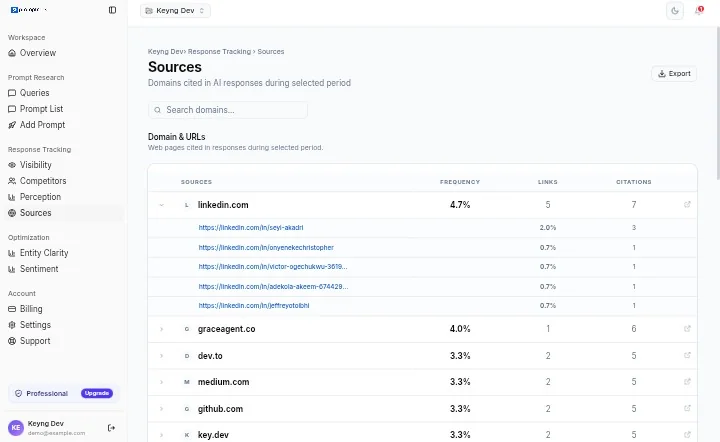
Domains, frequency, citation counts. Not a screenshot of a chat window.
"How often do you re-run the prompts, and what happens between runs?"
Model answers drift. A one-off audit is a photograph of a moving car. Weekly is a reasonable floor; anything less than monthly is theatre.
"What's your unit of measurement?"
If the answer contains the word "position" or "rank," stop. There are no positions in a generated answer. The units are share of voice, citation share, sentiment, and prompt coverage. A vendor still counting positions has mapped an old model onto a new problem.
"Which models do you cover, and how?"
"ChatGPT" is not an answer. Five major engines behave differently, and the one that matters most is whichever one your buyers actually use. Ask how they query them, whether the results are grounded in live search or the model's training data, and how they handle the fact that the same prompt returns different text on Tuesday than it did on Monday.
"What do I keep if I leave?"
Most answers here are "the reports." Ours is the source code, which we'll come back to.
What Engagements Actually Cost
Nobody publishes this, so here are honest bands.
| What you're buying | Typical cost | Fits when |
|---|---|---|
| Software licence only | $99 to $1,000+ per month | You have a marketing team to act on it |
| Managed GEO retainer | $2,000 to $8,000 per month | You want the work done, not just measured |
| One-off visibility audit | $1,500 to $5,000 | You're deciding whether this is worth budget |
| Self-hosted platform, owned | $99 one-off, or $499 with resale rights | You'd rather own the system than rent a seat |
| Custom tracking build | From $500, scoped | You need it wired into your own stack |
The bottom two rows are ours, and they're deliberately a different shape from the rest of the table. More on that in a moment.
One caution on retainers. A $2,000 monthly fee against a category with forty relevant prompts is fine. The same fee against a category with four is somebody billing you for a spreadsheet. Ask how many prompts they'll track and how they chose them before you agree a number.
What We Do Differently
We're an engineering team, not an agency with a GEO service line. That shapes the offer in a way worth being upfront about.
We built PromptRank because a client asked us to measure something nobody was selling a decent answer to. It runs prompts across ChatGPT, Claude, Gemini, Grok, and Perplexity through a queue-backed worker system, grounds each query in live search results before asking the model, extracts the exact sentences where a brand is named, and tracks the domains the models cite. It syncs with Google Search Console, so the prompts you track can come from queries you already know convert.
You can license it for $99, or $499 with resale rights, and run it on your own server. Installation is $150 flat if you'd rather not touch a VPS.
Here's the candid part. If what you want is a person who shows up every Monday and writes the comparison-page content and chases the review-site placements, a specialist agency will serve you better than we will, and we'll say so on the call. What we're good at is building the measurement layer and wiring it into systems you already run.
A B2B SaaS client came to us convinced they were invisible in AI answers. They weren't. They were being named in about a fifth of their category's prompts, but the models were describing them with a competitor's pricing model attached to their name.
That's not a visibility problem, it's an accuracy problem, and it needed three corrected source pages rather than a retainer. We ran the audit, told them that, and built them the tracking so they could watch it correct. The engagement was smaller than the one they came in asking for.
We'd rather have that conversation than the other one.
If you want it built into your stack rather than bought off a shelf, our custom development services page lists every plan and price, including the $500+ automation base for integration work.
The Category in Ninety Seconds
If you're briefing a colleague who hasn't followed any of this, this rundown covers the mechanics without the hype:
Frequently Asked Questions
What do generative engine optimization companies do?
They measure whether AI assistants name your brand when people ask buying questions in your category, then work on the two things that change that: the third-party sources models cite, and the structure and clarity of your own pages. The good ones show you the measurement before they sell you the work.
How much does a GEO company cost?
Managed retainers typically run $2,000 to $8,000 a month. Software licences run $99 to $1,000+ a month depending on whether you're renting a seat or buying the platform. One-off audits sit around $1,500 to $5,000.
Is GEO just SEO with a new name?
No, though plenty of vendors are selling it that way. The work overlaps, because models lean heavily on pages that already rank. The measurement doesn't overlap at all: there are no positions, no click-through rate, and no fixed result set to track.
How do I know if a GEO company is any good?
Ask which sources a model cited in its last answer for your category. A team with real tracking answers immediately from stored data. A team without it promises to pull it together after you sign.
Can I do this in-house?
Yes, if someone owns it weekly. The reason most teams don't is that running five model backends on a schedule and storing the citations is an engineering job, not a marketing one. That's the gap our platform fills.
How long before it moves?
Expect eight to twelve weeks before source changes show up consistently in model answers, and treat any single week's reading as noise. The trend is the signal.
Choosing Without Guessing
Shortlist three generative engine optimization companies, ask all five questions, and notice who answers with data and who answers with a case study. That single filter will remove half your list on the first call.
Then decide what you actually want to own. If the answer is a report every month, buy the retainer from a specialist and hold them to the units above. If the answer is a system your team runs, look at the platform route instead.
Either way, get a reading of where you stand before anyone quotes you. Ours is free to look at: click through the PromptRank demo, or read our team and track record if you'd rather know who you'd be working with first.
And if you'd like us to scope the build, tell us what you're measuring and we'll come back with a fixed price. No retainer, no lock-in, and the code is yours at the end. Nobody buys what they can't see.