What an LLM SEO Tool Actually Measures
An LLM SEO tool measures mentions, citations, and sentiment inside model answers instead of positions. Here is what it tracks, and where it stops working.
An LLM SEO tool measures four things a rank tracker can't see: how often a model names your brand across the prompts your buyers actually type, which competitors it names instead, which websites it cited to build the answer, and what it says about you when it does. The unit is a mention, not a position.
You already know how SEO works, so we'll skip that part. What's worth your attention is the measurement problem, because it's genuinely different and most of the category is selling a dashboard that pretends it isn't.
Here's the honest framing. This is an emerging category with real limitations, and anyone telling you they can guarantee a mention in ChatGPT is selling you something.
What a good tool gives you is visibility into a channel you currently can't see at all. That's worth a lot. It just isn't the same as control.
Key Takeaways
- The four measurable signals are share of voice, citation sources, sentiment, and prompt coverage. Positions don't exist.
- Model answers drift week to week, so a one-off audit is worthless. Tracking has to be scheduled.
- Your citations mostly aren't yours. Models lean on third-party pages, which is where the actual work sits.
- Classic SEO tooling fails here for a structural reason: it parses an HTML results page, and there isn't one.
- PromptRank runs this across five engines and costs $99 to license, or $499 with resale rights.
When the Answer Replaces Links
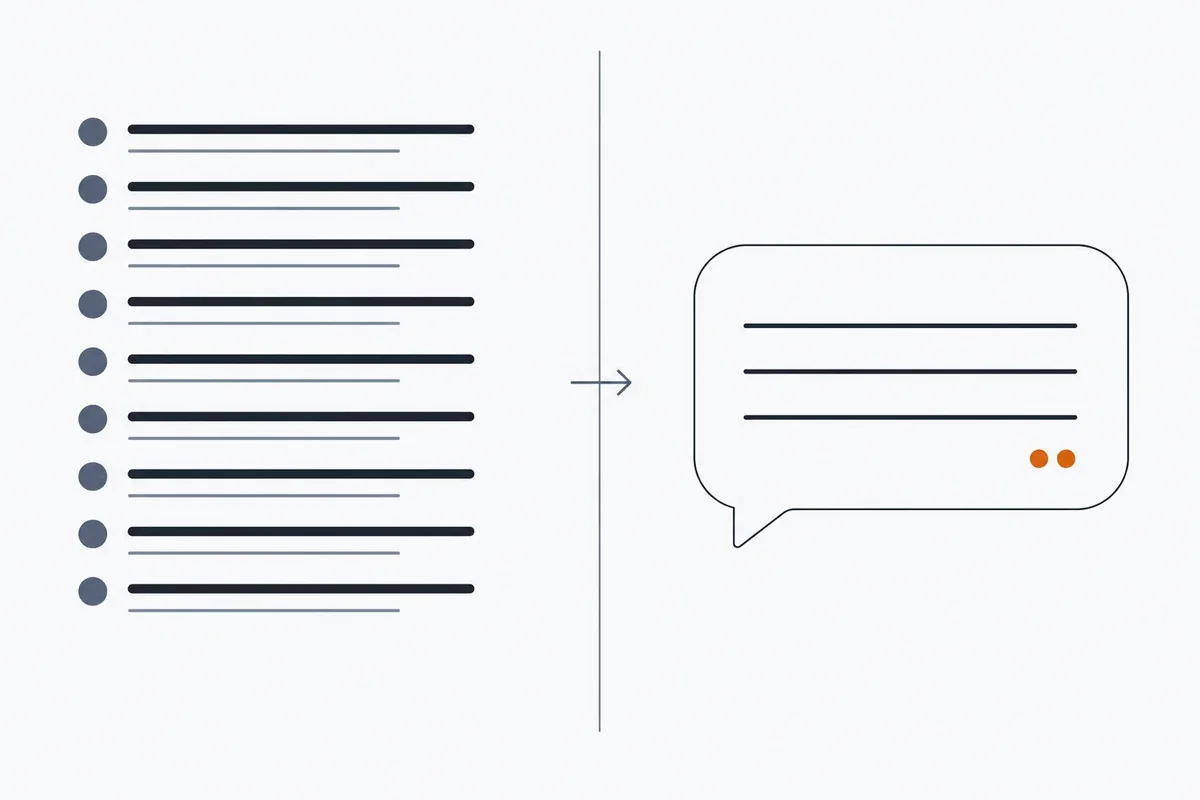
Ten blue links became one paragraph. Everything downstream of that changes.
There's no position to hold, because there's no list. There's no click-through rate on a mention, because the answer often resolves the question outright. There's no fixed result set, because the same prompt returns different text tomorrow. And there's no query string to optimize against, because people type sentences, not keywords.
What survives is simpler than the category's marketing suggests. Models cite sources. The original GEO research from Princeton found that adding citations, quotations, and statistics to a page lifted its visibility in generated answers by up to 40%. That's a content structure finding, not a magic one.
Google is equally blunt in its own documentation: there are no special optimizations required for AI Overviews or AI Mode beyond being indexable and being good. So the advantage isn't in a secret technique. It's in knowing where you currently stand, which nobody can tell you without running the queries.
That's the job an LLM SEO tool does.
Curious what your own reading looks like? The PromptRank demo is open, and you can run a prompt against five engines without talking to us first.
The Four Signals Worth Tracking
Every tool in this category claims a dozen metrics. Four of them matter.
Share of voice. Across the prompts in your category, how often does the model name you versus each competitor? This is the closest thing to a ranking that exists here, and it's the number to put on a board slide.
Cited sources. Which domains did the model actually pull from to answer? This is the most actionable signal by a distance, and we'll come back to why.
Sentiment and attributes. Being named isn't the same as being named well. Models attach adjectives, and "expensive" or "hard to set up" attached to your name across forty answers is a problem no position metric would ever have surfaced.
Prompt coverage. How many of the questions your buyers ask do you appear in at all? A brand at 60% share of voice across five prompts is in worse shape than one at 20% across eighty.
Here's what those look like running together:
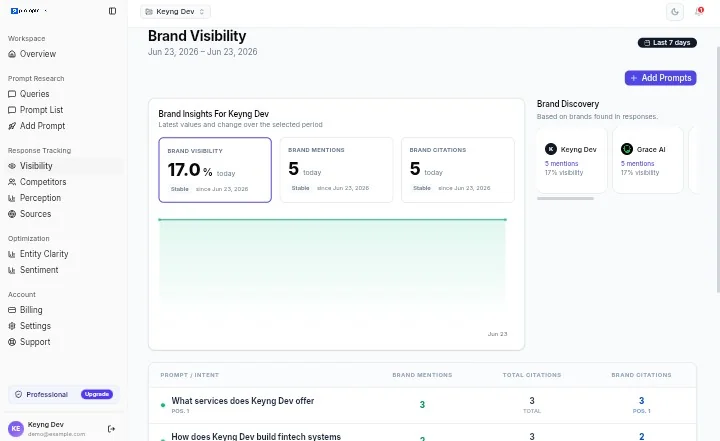
Note the per-prompt rows at the bottom. That's the level the work actually happens at, not the headline percentage.
Why Your Citations Aren't Yours
This is the finding that surprises most SEO people, so it gets its own section.
When you pull the cited sources for your category, your own domain usually isn't the biggest one. Review sites are. Forum threads are. Documentation pages, comparison articles, and a Reddit post from 2024 are.
Models are synthesising a consensus, and consensus lives on third-party pages. Which means a large slice of the work is not on your site at all. It's making sure the pages the models already trust say something accurate and specific about you.
That reframes the effort in a way worth planning around. If your top cited domain for the category is a comparison site that lists you with the wrong pricing model, fixing that one page moves more than a quarter of rewriting your homepage will.
We saw this cleanly on a client engagement. A B2B platform came to us convinced they were absent from AI answers. They weren't absent.
They were being named in about a fifth of their category's prompts, but with a rival's pricing structure attached to their name, because two widely cited comparison pages had it wrong. Three corrected source pages, and the descriptions came right over the following six weeks. No content calendar involved.
Where Classic SEO Tooling Stops
Your existing stack doesn't fail here because it's badly built. It fails for a structural reason.
| Classic SEO tool | LLM SEO tool | |
|---|---|---|
| What it reads | An HTML results page | A generated answer |
| Unit of measurement | Position, 1 to 100 | Mention, citation, sentiment |
| Input | Keyword | Conversational prompt |
| Stability | Same page all day | Different text run to run |
| Coverage | One engine per query | Five engines per prompt |
| Actionable output | Rank up or down | Which sources shaped the answer |
A rank tracker parses a document at a URL. There is no document. There is a model generating text on demand, differently each time, from sources it chose in that moment.
You can bolt an AI Overviews column onto a rank tracker, and several have, but that's scraping one surface of one engine. It isn't the channel.
Where the two genuinely connect is upstream. Pages that rank well tend to be pages models cite, so your existing SEO work is not wasted. It just isn't measurable through the same instrument any more.
Search Console is still worth wiring in, though, and for a specific reason. The long-tail queries you already convert on are the best possible starting list of prompts to track. That's real data about how your buyers phrase things, and it beats a brainstormed prompt list every time.
How a Tracking Run Works
Worth understanding before you evaluate anything, because it's where tools differ most and nobody explains it.
Two details in that flow decide whether the numbers mean anything.
Grounding. Fetching live search results before asking the model matters enormously. Without it you're measuring the model's training data, which is months stale and hallucinates citations. With it you're measuring what a real user would see today.
Scheduling. Answers drift. Re-running on a fixed cycle is what turns a reading into a trend, and the trend is the only thing you can act on. Any single week is noise.
If a vendor can't tell you whether they ground their queries, you don't have a measurement tool. You have a chatbot with a chart on it.
The Shift in Six Minutes
If you need to brief a colleague who still thinks of this as an SEO tooling upgrade, this is a clean summary of what actually changed:
What This Category Can't Do
The anti-hype section, because you'd be right to be sceptical.
It can't guarantee a mention. Nobody controls what a model says. You influence the sources it reads. That's the whole lever, and it's indirect.
It can't attribute revenue cleanly. A mention in ChatGPT that leads to a branded search three days later shows up in your analytics as direct traffic. The attribution problem here is worse than social was in 2012, and anyone claiming a clean ROAS number is modelling, not measuring.
It's slow. Expect eight to twelve weeks between fixing a source page and seeing it settle into answers consistently.
Sample size is a real limit. Thirty prompts across five engines is 150 answers a cycle. That's enough for a trend and nowhere near enough for statistical confidence on a small shift.
We'd rather tell you that now than have you discover it in month three. Garbage in, garbage out applies to measurement too.
Running It on Your Own Stack
Two ways to get this, and they suit different people.
Rent a seat. Profound is the enterprise option at around $1,000 a month and it's genuinely capable if you have that budget. Otterly.ai does mention alerting well for comms teams. Geoptie handles lighter agency auditing. All three are fine products; you're renting access and their roadmap is theirs.
Own the platform. PromptRank is the one we build. It runs prompts across ChatGPT, Claude, Gemini, Grok, and Perplexity through queue-backed workers, grounds every query in live search first, extracts the exact sentences where a brand is named, tracks cited domains, scores sentiment, and syncs with Search Console so your prompt list comes from queries you already know convert. It's $99 to license, or $499 with resale rights if you want to run it for clients under your own brand.
You'll need a VPS rather than serverless hosting, because the background workers and the scheduled cron need to keep running. If that's a blocker, installation is a flat $150 and you'll be live in 48 hours.
Here's the candid part. If you need this reading once, to decide whether the channel deserves budget at all, don't buy anything yet. Run a handful of your category's prompts through the demo by hand and see what comes back. If you're already convinced and want it tracked weekly without paying a per-seat fee forever, owning the platform is the cheaper end of the same road.
Want it wired into systems you already run? Our custom development services page covers integration work from a $500 base, and whatever we build stays yours.
Frequently Asked Questions
What is an LLM SEO tool?
Software that runs your category's buying questions through large language models on a schedule and records whether your brand was named, who was named instead, which sources the model cited, and how it described you. It replaces position tracking with mention and citation tracking.
How is it different from a rank tracker?
A rank tracker parses an HTML results page and reports a position. An LLM SEO tool reads a generated answer, which has no positions, changes between runs, and differs across five engines. The two measure different channels with different units.
Can I just use ChatGPT manually to check?
For a one-off sanity check, yes, and we'd recommend it before you spend anything. It falls apart as a method because answers drift, you can't compare weeks, and you'll unconsciously phrase prompts in your own favour.
How much does an LLM SEO tool cost?
Hosted platforms run roughly $99 to $1,000+ a month depending on tier. Self-hosted, ours is $99 once, or $499 with resale rights, plus $12 to $40 a month for a server.
How long until changes show up in AI answers?
Eight to twelve weeks is a realistic window for source-page changes to settle in consistently. Treat any single week's reading as noise.
Does my existing SEO still matter?
Yes, more than the category's marketing admits. Models lean heavily on pages that already rank well. Your SEO work still feeds this channel; it just isn't measurable with the same instrument.
Where to Start
Pull twenty long-tail queries out of Search Console, the ones that already convert. Run them through an LLM SEO tool, ours or anyone's, and look at two columns first: how often you're named, and which domains the model cited.
That second column will tell you where the next quarter's work is. It's usually not on your own site, and that's the single most useful thing this category has taught us.
Start with the PromptRank demo if you'd rather see a reading than read another explanation, or the licensing page if you already know you want to own it rather than rent it. And if you want it built into your own stack, tell us what you're measuring and we'll quote a fixed price.
Nobody buys what they can't see. That now includes what the models are saying about you.