What an SEO Automation Tool Should Automate
An SEO automation tool should automate research, drafting, and scoring, and never the publish decision. Where the line sits, and the tools worth evaluating.
An SEO automation tool should automate research, keyword verification, outlining, drafting, scoring, and scheduling. It should never automate the decision to publish. That one boundary is the difference between a content operation that compounds and a site full of pages nobody reads.
You're right to be sceptical, by the way. Most of this category has spent two years producing exactly the kind of output Google now names in its spam policies as "scaled content abuse": many pages generated to manipulate rankings rather than help anyone. Pretending that didn't happen would be a strange way to open a page selling you automation.
So here's the more useful thing. This blog runs on the pipeline we sell, and we'll show you which steps are machine and which are human, including the ones where the machine got it wrong this month.
Key Takeaways
- Safe to automate: keyword verification, research, outlining, first drafts, quality scoring, image generation, scheduling.
- Never automate: intent decisions, factual claims about your own product, competitor statements, and the publish button.
- Automation makes bad strategy faster. Garbage in, garbage out applies at scale.
- Byword, ZimmWriter, n8n, and Koala each solve a different slice; the differences are hosting, control, and cost model.
- AgentSEO is $69 to license, or $350 with resale rights, and runs the pipeline on your own server.
What Is Safe to Automate
The test is simple. If a step has a verifiable right answer, automate it. If it needs judgement about your business, don't.
Keyword verification. Volume, CPC, difficulty, and search intent are lookups. Doing them by hand is slow and no more accurate. This one is not just safe to automate, it's negligent not to.
Research. Pulling the current top results, the People Also Ask questions, and the themes competitors cover is mechanical gathering. A machine does it faster and misses less.
Outlining. Structuring an H2/H3 skeleton to a target length is pattern work, provided a human has already decided the angle.
First drafts. Section by section, with each section reading the previous one so the argument holds together. A first draft is raw material, not output.
Quality scoring. Readability, paragraph length, keyword placement, heading shape, link policy, banned phrases. All countable, and all better checked by a script than by a tired human at 6pm, which is roughly the standard Google's own quality guidance sets for content made for people rather than for rankings.
Image generation and compression. Heroes, concept illustrations, WebP conversion, size budgets. Mechanical.
Scheduling and publishing mechanics. Once a human has approved a piece, pushing it to WordPress with the right metadata is plumbing.
That list covers most of the hours in a content operation. Which is the actual argument for automation, and it doesn't require anyone to believe a machine can write well.
Want to see the pipeline running? AgentSEO's demo is open and you can watch an agent work through it.
What Still Needs a Human
Four things, and the fourth is the one people skip.
The intent decision. Whether a keyword deserves a comparison page, a money page, or nothing at all is a judgement about your business model. Get it wrong and you've automated the production of well-written pages serving the wrong reader.
We know, because that's exactly what happened on this site: six published posts, 4,279 impressions, four clicks. Every one of them was competent. Every one answered a question the searcher wasn't asking.
Claims about your own product. A model will confidently describe features you don't have, menus that don't exist, and pricing you never set. Every product claim needs someone who knows the product to read it.
Anything about a competitor. Naming a rival's price or weakness from a model's memory is how you publish something defamatory or just wrong. Sourced by a human, or cut.
The publish decision. This is the boundary. Everything upstream can be a background job. Someone still has to read the thing and decide it's worth their name.
Here's where that happens in our own workflow, and it's deliberately a full editor rather than an approve button:
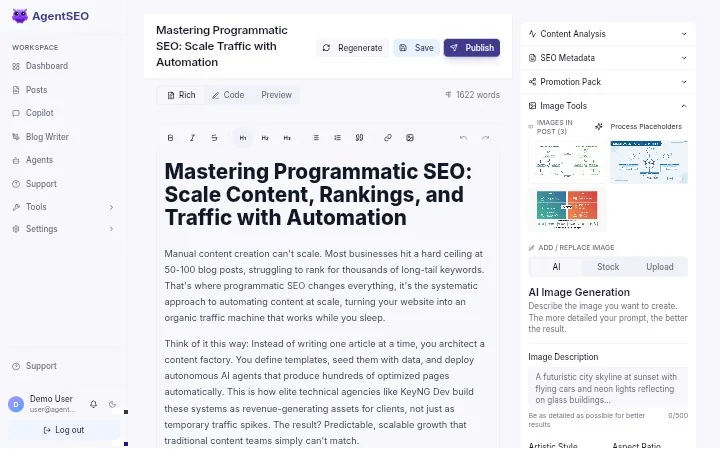
Human in the loop isn't a compliance phrase. It's the step that decides whether the other twenty are worth anything.
How We Run This Blog
The self-demonstrating part, including the embarrassing bits.
This site's content pipeline is automated at seven of its nine steps. Keywords get verified against real volume, CPC, difficulty, and intent data before anything is written, which is how we discovered that a chunk of our earlier calendar was built on keywords with the wrong intent recorded.
Research, outlining, and section-by-section drafting run as background jobs. A scrubber strips AI tells and invisible watermark characters. A scorer rates five dimensions and refuses anything under 70. Images are generated, cropped, and compressed to a size budget automatically.
The two manual steps are the intent gate at the front and the publish decision at the back.
Now the part that argues our own case better than any feature list.
This month the automation broke two things, and a human caught both. The scrubber had a rule stripping whitespace before punctuation, and because an exclamation mark opens every markdown image, it was silently deleting the blank line before every hero image and gluing it onto the heading above. Ten posts would have published with broken images.
The second one was worse. The automated content calendar scheduled a brand-new post against a URL that already had a live article on it. Publishing it would have meant either a collision or a slug change, and changing a published slug forfeits every ranking signal that page holds.
Neither failure was a writing failure. Both were process failures that no quality score would ever have caught, and both were found by someone reading the output. That's the argument for the boundary, and we'd rather show you a real one than assert it.
Here's the agent monitor for the automated half:

The Tools Worth Evaluating
Four alternatives, and they genuinely suit different people.
| Byword.ai | ZimmWriter | n8n | AgentSEO | |
|---|---|---|---|---|
| Shape | Hosted article writer | Windows desktop app | Workflow builder | Self-hosted platform |
| Cost model | Per-article credits | One-off licence | Subscription or self-host | $69 once, $350 with resale |
| Runs headless on a server | Yes | No | Yes | Yes |
| Your own model keys | No | Yes | Yes | Yes |
| Private docs for grounding | No | Limited | Via custom nodes | Yes, knowledge base |
| Setup effort | Lowest | Low | Highest | Medium |
Byword.ai is the easiest way to produce programmatic clusters at scale, and if volume is genuinely your strategy it does that well. The costs are recurring and per-article, the prompt engine is closed, and you can't feed it your own sales documentation for grounding.
ZimmWriter is excellent value for bulk generation and has a devoted following among niche site builders. Its constraint is architectural: it's a Windows desktop application, so it can't run on a Linux server, in Docker, or on a schedule without a machine sitting on somewhere.
n8n is the most flexible option here and the right answer if you want to wire your own steps together. The trade is maintenance. Blogging workflows built on it tend to be fragile chains of nodes with their own API limits, and every provider change is a debugging session. If you enjoy that, it's genuinely powerful.
Koala is a solid hosted writer in the same family as Byword, with the same rental economics.
Honestly, if you publish fewer than four articles a month, none of these pay for themselves against just writing them. The economics only turn at volume, and we'd rather say that than sell you a licence you'll use twice.
Running the Pipeline Yourself
AgentSEO is the one we build, and it exists because we wanted the pipeline without the per-article meter.
It runs a multi-stage writer: it searches for real search intent, builds an outline, drafts section by section with each section reading the last, scores the result against a quality gate, and forces a rewrite if the score fails.
Background agents handle the rest. A calendar agent triggers scheduled posts. A performance agent pulls Search Console and Analytics data to find striking-distance keywords sitting at positions 11 to 20. A trend agent scrapes subreddits you nominate and fills the calendar with ideas.
You supply your own model keys, so content costs you raw API prices rather than a marked-up credit. You can upload your own documents so the AI grounds claims in your actual product rather than its imagination. And it publishes to WordPress through application passwords, or to a custom site through a signed webhook.
It's $69 for a single deployment or $350 with resale rights if you're running it for clients under your own brand. It needs a VPS rather than shared hosting, because the agents are long-running background processes, and installation is a flat $150 if you'd rather not do that part.
The candid version: this is a platform, not a magic button. It will produce a competent draft on a bad keyword just as happily as on a good one. What it buys you is the seven mechanical steps, so the hours you have left go into the two that need you.
If you'd rather have it wired into systems you already run, our custom development services cover integration work from a $500 base and the code stays yours.
Automating Without Getting Penalised
If the risk side is what's holding you back, this covers the boundary well:
Frequently Asked Questions
What is an SEO automation tool?
Software that runs the mechanical parts of a content operation without a person driving each step: keyword verification, research, outlining, drafting, quality scoring, image generation, and scheduling. The good ones stop short of publishing and hand a draft to a human.
Will automated content get my site penalised?
Not for being automated. Google's spam policies target scaled content abuse, meaning many pages produced to manipulate rankings rather than help users. The penalty risk comes from publishing unreviewed volume, which is precisely the step you should keep manual.
What should never be automated?
The intent decision, any factual claim about your own product, anything you say about a competitor, and the publish button. Everything else is fair game.
How much does an SEO automation tool cost?
Hosted tools charge per article or per month, typically $50 to $500 a month at real volume. Self-hosted, AgentSEO is $69 once or $350 with resale rights, plus your own model API spend and a $12 to $40 server.
Do I still need a writer?
You need an editor more than a writer. The drafting hours collapse; the judgement hours don't. Teams that get value from this are the ones who redeploy the saved time into strategy and review rather than banking it.
How many articles a month justifies this?
Four or more, roughly. Below that the setup and review overhead outweighs what you save, and writing them yourself is genuinely the better call.
Where to Start
Pick your five most valuable keywords and verify their intent before you automate anything. If that step surprises you, and it surprises most people, you've just found more value than any drafting tool will give you this year.
Then automate the mechanical middle and keep both ends. Human at the front deciding what deserves a page, machine through research and drafting and scoring, human at the back deciding it's good enough to carry your name.
Open the AgentSEO demo and run one article through it end to end. Watch where you'd want to intervene, because that's where the boundary sits for your business, and it may not be exactly where it sits for ours. If it fits, the licensing page has both tiers listed publicly.
Automation makes a good process faster and a bad process faster. Choosing an SEO automation tool is mostly about being honest which one you currently have.