How to Become a White Label SaaS Reseller
A white label SaaS reseller buys a licence once and sells access under their own brand. Here is what each licence permits, plus a worked margin table.
A white label SaaS reseller buys a software licence once, puts their own name and logo on it, and charges customers a recurring fee to use it. Your cost is fixed at purchase. Your revenue isn't. That gap is the whole business.
The catch nobody spells out is which licence lets you do that legally, and most listings are deliberately vague about it. We sell on these marketplaces, so we'll be specific instead.
Here's the part most people get wrong on the first attempt. They buy the cheapest licence, launch a paid product on it, and find out six months in that the licence they bought forbids charging end users. That's not a technicality. It's the difference between a business and a takedown notice.
Key Takeaways
- A regular licence covers one deployment whose users pay you nothing. If you charge users, you need an extended licence. Full stop.
- Our extended licences run $299 to $499 depending on the platform, paid once.
- At $49 a month per customer, a $499 licence pays for itself with eleven customers, and everything after that is margin against a hosting bill of roughly $12 to $40.
- The real cost isn't the licence, it's support. Budget for it before you price.
- Setup is the usual blocker, so installation is a flat $150 if you'd rather not touch a server.
How the Reseller Model Works
You're not building software. You're distributing it.
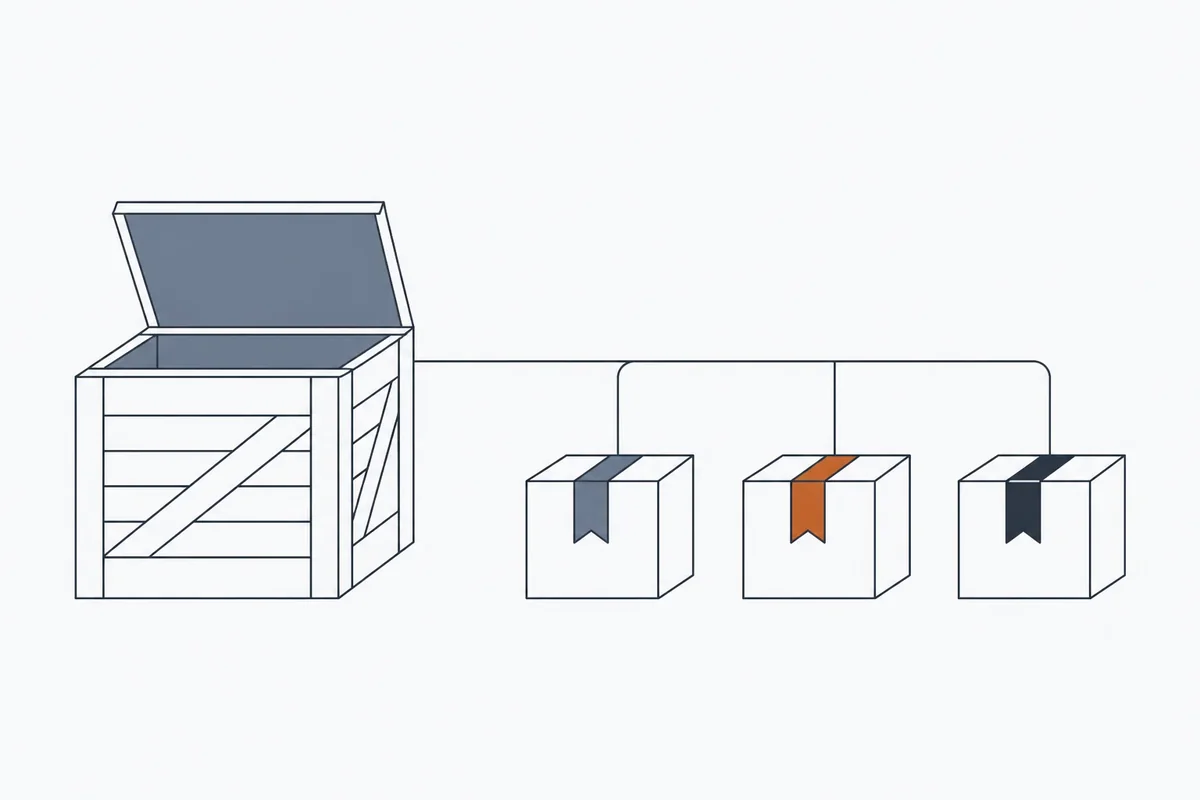
Buy the platform once. Deploy it on a server you control. Change the logo, the name, the colours, and the domain so it reads as yours.
Then set your own subscription plans and connect your own payment gateway. Customers sign up, pay you, and never see where the code came from.
Three things make this work better than building:
The cost is fixed and known before you start. A comparable platform built from scratch runs $8,000 to $18,000 and takes four to eight weeks. A licence is a few hundred dollars and a weekend.
The revenue is recurring, the cost isn't. You pay once. Customers pay monthly. Every month after the first is arithmetic in your favour.
You keep the customer relationship. No revenue share, no marketplace cut, no platform that can change its pricing on you. Your list is yours.
The trade-off is real too, and worth stating. You didn't build it, so you can't change it fundamentally without a developer. If your differentiator depends on a feature the platform doesn't have, you're either paying for customization or you're back to building.
Want to see what you'd be reselling before you read the licence terms? Every platform on our white-label SaaS products page has a live demo you can log into.
What the Extended Licence Permits
This is the section to read twice.
Marketplace licences come in two grades, and the dividing line is whether your users pay you. CodeCanyon's published terms put it plainly: a regular licence covers use "in a free end product," while an extended licence covers "use in an end product that's sold."
| Regular licence | Extended licence | |
|---|---|---|
| Deploy on your own server | Yes | Yes |
| Rebrand it completely | Yes | Yes |
| Give access away free | Yes | Yes |
| Charge users a subscription | No | Yes |
| Charge a client for setup work | Yes | Yes |
| Resell the source code itself | No | No |
Two exclusions catch people out.
You can't resell the code. Neither licence lets you hand the source files to someone else, sell them, or list them as your own product. You're selling access to a running service, not a codebase.
One licence covers one end product. If you want to stand up a separate branded instance for each of five clients, that's five end products under most marketplace terms, not one. If that's your model, talk to us before you buy, because there's a cleaner arrangement for it and guessing here is expensive.
If you ask us, the ambiguity in this category is mostly deliberate on the seller's side. Vague terms sell more licences. We'd rather you buy the right one and stay.
A Worked Margin Example
Vague earning claims are worthless, so here's actual arithmetic on our own numbers.
Say you license PromptRank with resale rights for $499, pay us $150 to install it, and rent a VPS at $24 a month, which is roughly a 4GB DigitalOcean droplet. Your setup cost is $649 and your running cost is $24 plus API spend.
You sell three plans at $29, $49, and $99 a month. Assume an average of $49.
| Customers | Monthly revenue | Monthly costs | Monthly margin | Months to break even |
|---|---|---|---|---|
| 5 | $245 | ~$85 | $160 | 5 |
| 11 | $539 | ~$140 | $399 | 2 |
| 25 | $1,225 | ~$260 | $965 | 1 |
| 50 | $2,450 | ~$450 | $2,000 | 1 |
Costs include the VPS plus the API spend the platform burns on behalf of your users, which scales with usage and is the number most people forget. On PromptRank that's OpenRouter and Serper; on AgentSEO it's whichever model keys you supply. You control the markup because you set the plan prices and the credit costs per action.
Eleven customers at $49 clears the whole setup. That's a realistic first-quarter target for someone with an existing audience and an unrealistic one for someone starting cold, which brings us to the part the margin table hides.
The real cost is support. Twenty-five customers will generate questions, and answering them is your job now, not ours. Price for that. A $19 plan with a human answering emails is a worse business than a $49 plan with the same person answering fewer of them.
Platforms You Can Resell Today
Three, and they suit different audiences.
PromptRank tracks how ChatGPT, Claude, Gemini, Grok, and Perplexity describe a brand: which prompts mention you, which name a competitor, what the models cite, and how sentiment shifts. Agencies resell this to clients who keep asking whether AI knows they exist. $99 regular, $499 extended.
AgentSEO is a content platform with background agents that research, outline, draft, score, and publish articles, plus a WhatsApp and Telegram copilot and four payment gateways already wired in. $69 regular, $350 extended.
Keyng Koin is a Telegram tap-to-earn game template on TON, built with Redis and queue workers to hold up past 100k concurrent taps. $49 regular, $299 extended.
All three ship with the parts that usually make a "white-label" purchase collapse: multi-tenant accounts, subscription billing, an admin economy where you set what each action costs, a branding editor, and a landing page CMS. That last list is the actual buying criteria, and we'll come back to why in a second.
Here's what the branding side looks like in practice, from the AgentSEO admin:
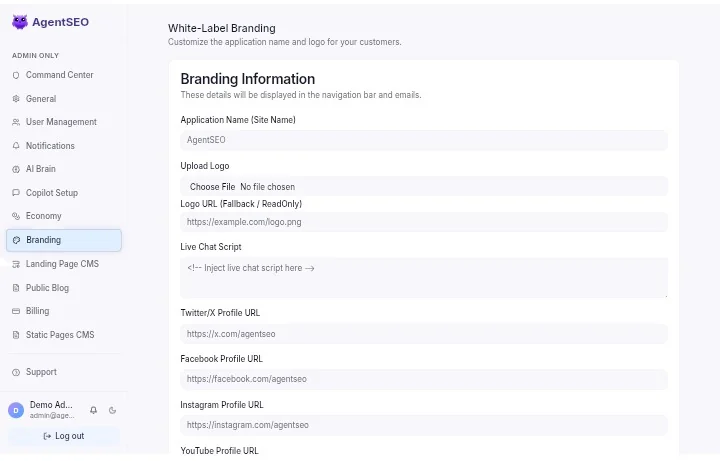
Logo, name, colours, and social links. No code, no build step.
Where Resellers Actually Fail
We've watched enough of these go wrong to name the pattern.
The most common failure is buying a demo. Plenty of listings look like a SaaS and turn out to be a single-user tool with a login screen bolted on: no tenant isolation, no billing, no admin panel, no way to suspend a customer who charges back. You find out when your second customer signs up and sees the first one's data.
Check for four things before you buy anything, ours included.
- Can you create a second account and confirm it can't see the first one's work?
- Is there a billing screen with a real gateway behind it, not a placeholder?
- Can an admin set plan limits and suspend a user?
- Is there a way to change the logo without editing files?
If a demo won't let you test those, it isn't a platform.
One of our own buyers came to us after exactly this. He'd bought a cheaper script, sold six subscriptions on it, and then discovered it had no per-tenant separation, so cancelling one customer took the others offline with them. We migrated his six accounts onto AgentSEO over a weekend and set the plan economy up so his credit costs matched his pricing.
He kept every customer. He'd have kept his money too if he'd run those four checks first.
Ready to run those checks on ours? The live demos are open, and the second account you create is genuinely a second tenant.
The Model in Five Minutes
If you want the broader case for distributing software instead of building it, this covers the economics well:
Frequently Asked Questions
What is a white label SaaS reseller?
Someone who licenses finished software, rebrands it as their own, hosts it, and charges customers a recurring fee for access. The reseller owns the customer relationship, the pricing, and the brand. They don't own the source code.
Do I need an extended licence to resell SaaS?
Yes, if your users pay you anything. A regular licence only covers an end product that's free to its users. Charging a client for installation or consulting is fine on a regular licence; charging users a subscription is not.
How much does it cost to start?
On our platforms, $299 to $499 for the extended licence, an optional $150 for installation, and $12 to $40 a month for a VPS. Under $700 to be live, which is roughly one twentieth of building the same thing.
Can I resell to multiple clients under one licence?
Generally no. Most marketplace terms treat each separately branded, separately sold instance as its own end product. If per-client deployments are your model, ask us for the right arrangement before you buy.
What happens when I need a feature the platform doesn't have?
You pay for it once and keep it. Our SaaS Customization Plan handles new features, extra payment gateways, and UI changes on a quoted basis, and the changes stay in your deployment.
Is white label the same as reselling someone else's subscription?
No, and this matters. Reselling a subscription means you're a middleman on someone else's platform, at their price, subject to their terms. White label means the software runs on your server under your brand, and nobody can reprice you.
Starting Your Reseller Business
Pick the platform whose customers you can already reach. That's the whole selection criteria, honestly. An SEO consultant with forty clients should look at PromptRank or AgentSEO; someone with a Telegram community should look at Keyng Koin. The best platform is the one you have an audience for.
Then run the four checks on the demo, buy the extended licence rather than the cheap one, and get it installed before you sell anything. Deploy, get feedback, come back stronger.
Start on our white-label SaaS products page, where every licence tier and price is listed in public. If servers aren't your thing, the VPS Installation Plan is a flat $150 and you'll be live in 48 hours.
And if you're weighing whether to become a white label SaaS reseller at all or commission something custom, our rule is simple: if a platform covers 90% of what's in your head, license it and pay to adjust the last 10%. If it doesn't, build. We'll tell you honestly which one you're looking at.