How an AI Visibility Tracking Tool Works
An AI visibility tracking tool re-runs your prompts on a schedule because model answers drift. How to set the cadence, and how to read a move correctly.
An AI visibility tracking tool re-runs your category's buying questions through the major AI models on a fixed schedule and records how the answers change. That word, schedule, is the entire product. Ask a model the same question twice in one week and you'll often get two different lists of recommended brands.
Which means the audit you paid for last quarter is worthless now, and probably was worthless within a fortnight of arriving.
Here's the part most teams discover the expensive way. They commission a one-off AI visibility report, act on it, and then have no idea whether anything they did worked, because they have exactly one data point and nothing to compare it to.
Key Takeaways
- Model answers drift week to week even with no change on your side, so a snapshot tells you almost nothing.
- Weekly is the right default cadence. Daily is noise; monthly hides real movement.
- Track four signals: prompt coverage, share of voice, cited sources, and sentiment.
- Treat any single week's move under about 10 points as noise. Act on three-week direction.
- PromptRank re-runs stale prompts automatically every seven days and is $99 to license.
Why Answers Change Week to Week
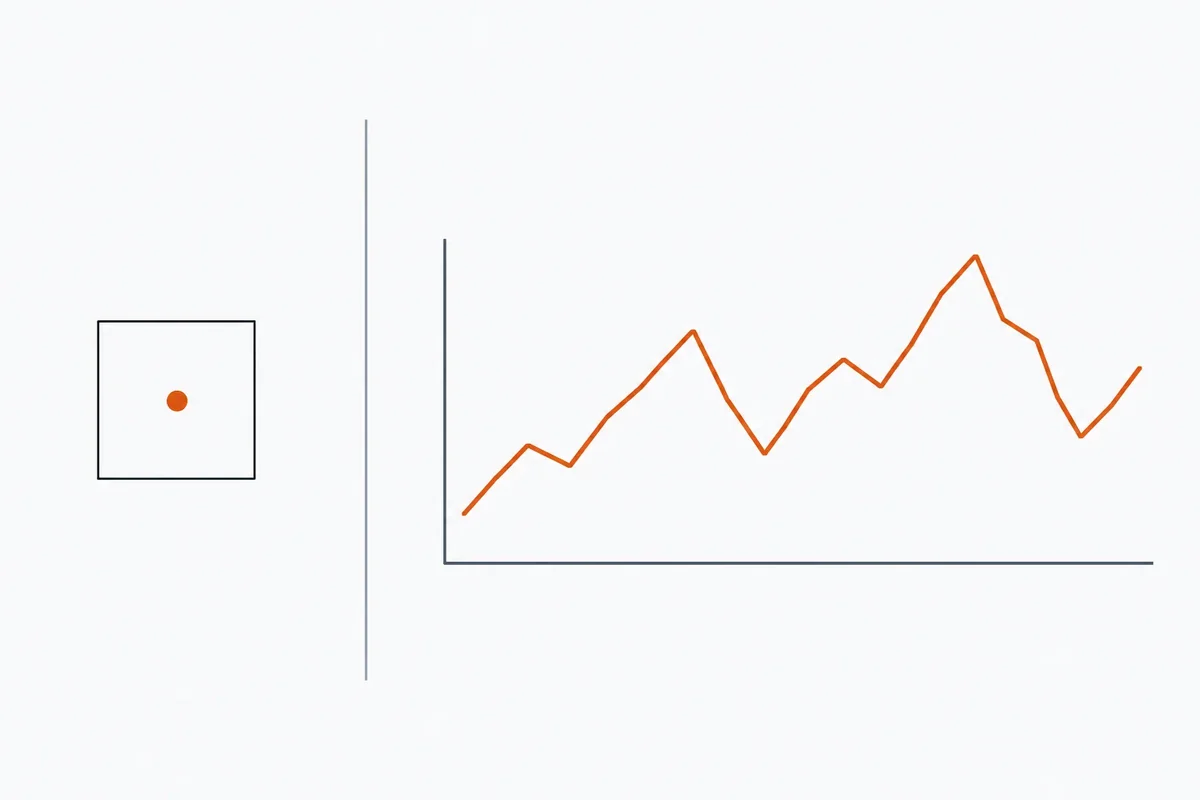
Four things move underneath you, and only one of them is anything you did.
The sources move. Models grounded in live search read whatever ranks today. A new comparison article, a Reddit thread that gained traction, a competitor's fresh landing page: any of these changes the raw material before the model even starts generating.
The models move. Providers ship updates constantly, and Google's own documentation on AI features is explicit that these surfaces fan a single query out across multiple related searches, so the source set changes with them. A version bump can change how a model weighs recency, how many sources it synthesises, and how willing it is to name specific brands at all.
Generation is probabilistic. Even holding everything else constant, the same prompt produces different text. That's not a bug in the tracking tool, it's how the systems work, and any vendor implying otherwise is misleading you. It's also why the original GEO research from Princeton frames visibility as something you shift statistically rather than something you set.
Your competitors act. They're publishing too, and the pages the models read are a shared pool.
Put those together and a single reading is a photograph of a moving car. You can tell roughly where it was. You cannot tell where it's going, which is the only question worth asking.
Want to see how much yours moves? The PromptRank demo runs a live prompt across five engines, and you can run the same one twice.
The Four Signals to Track
Briefly, because the deeper treatment of what these measure lives in our piece on what an LLM SEO tool measures. What matters here is how each one behaves over time.
| Signal | What it is | How it moves |
|---|---|---|
| Prompt coverage | Share of your tracked prompts that name you at all | Slowest and most reliable. Real progress shows here first |
| Share of voice | You versus competitors across those prompts | Noisy week to week; meaningful over a month |
| Cited sources | Domains the models read to answer | Changes in steps, not curves. A new source appearing is an event |
| Sentiment | Attributes attached to your name | Slowest of all, and the one worth alerting on |
The useful distinction is between signals that drift and signals that step.
Share of voice drifts continuously, so you read it as a line. Cited sources change in discrete jumps, so you read them as events: a domain entering or leaving your top ten is worth investigating the same day, while a two-point share-of-voice wobble is not worth a meeting.
Sentiment deserves special attention because it moves slowest and matters most. If "expensive" or "hard to set up" starts appearing beside your name, that's a positioning problem that took weeks to form and will take weeks to unwind. Catching it in week two is worth far more than catching it in week ten.
Tracking That Runs Itself
The failure mode here isn't picking bad prompts. It's that manual tracking quietly stops.
Someone runs the queries diligently for three weeks, gets busy, skips a cycle, then another, and the trendline has a hole in it exactly where the interesting thing happened. So the setup that matters is the one nobody has to remember.
Three things to get right at setup.
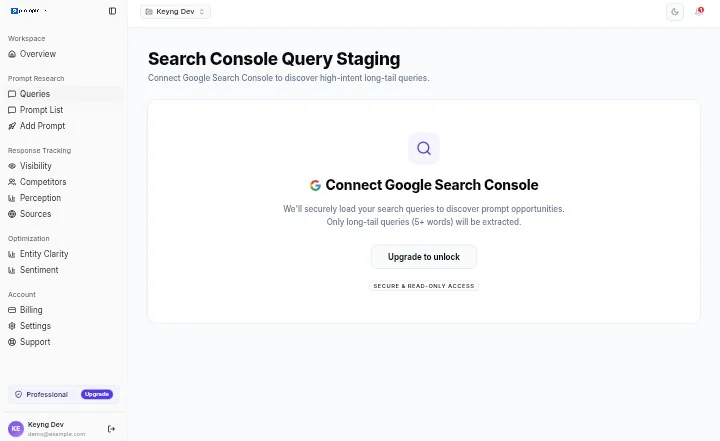
Get your prompt list from real data. Pull long-tail queries out of Google Search Console, specifically the ones that already convert. Those are your buyers' actual phrasing, and they beat a brainstormed list every time. PromptRank connects through Google OAuth, filters for queries of five words or more, and stages them for one-click tracking:
Fix the list before you start. A trendline only means something if the prompts stay the same. Adding twenty prompts in week six resets your baseline, so decide the core set up front, treat it as fixed for a quarter, and keep additions in a separate group.
Automate the cadence. A built-in cron should re-run stale prompts without anyone touching it. Ours runs every seven days by default and is configurable. If a tool requires a human to press run, assume the tracking stops within a month, because it usually does.
Thirty prompts across five engines is 150 answers a cycle. That's a background job, not a task on someone's list.
If you'd rather have it wired into reporting you already run, our custom development services cover integration work from a $500 base.
Reading the Trend Sensibly
Here's where most teams waste the data they just paid to collect: they react to every movement.
Three rules that have saved our clients a lot of pointless work.
One week is never a signal. Run-to-run variance on a thirty-prompt set is routinely five to ten points on share of voice with nothing changed at all. If you can't distinguish your movement from that band, you don't have a finding.
Direction beats magnitude. Three consecutive weeks of small decline is a real problem. One week of a large drop usually isn't. Watch the shape.
Go to the sources first. When something genuinely moves, the cause is almost always a change in what the models are reading, not something on your own site. Check which domains entered or left your citation list before you touch your content calendar.
And set expectations on speed. Fix a source page today and expect eight to twelve weeks before it settles into answers consistently. This channel is slow in both directions, which is frustrating when you're losing and reassuring when you're winning.
One of our clients spent most of a quarter rewriting their product pages because their share of voice dropped nine points in a single week. It recovered on its own the following cycle. The drop was variance. The rewrite wasn't wasted exactly, but it was a quarter of effort spent on the wrong end of the problem, and their citation list would have told them nothing had changed if anyone had looked.
What It Costs to Run
Two shapes, and the difference compounds.
Hosted platforms in this category run roughly $99 to $1,000+ a month depending on tier. Over three years that's between $3,500 and $36,000, and you're renting the whole time.
PromptRank is $99 to license for a single deployment, or $499 with resale rights if you're tracking on behalf of clients under your own brand. You run it on your own server, so add $12 to $40 a month for a VPS plus the API balances the tracking consumes, which scale with how many prompts you track.
The catch is honest and worth stating. Background workers and the scheduled cron mean this needs a Linux VPS, not shared hosting and not serverless, because those kill long-running processes. If that's the blocker, installation is a flat $150 and takes 48 hours.
If you have no engineer and no appetite for a server, a hosted subscription is genuinely the better buy and we'd say so on a call. The ownership argument only pays off if you're willing to own something.
Skip the server setup. The VPS Installation Plan is a flat $150, listed publicly with every other plan.
Where the Channel Is Heading
If you want the wider data on how AI search is actually being used before committing budget to tracking it:
Frequently Asked Questions
What is an AI visibility tracking tool?
Software that re-runs your category's buying questions through ChatGPT, Claude, Gemini, Grok, and Perplexity on a schedule, then records whether you were named, who was named instead, which sources the models cited, and how you were described. The scheduling is what separates it from a one-off audit.
How often should I track AI visibility?
Weekly for most businesses. Daily produces more noise than signal outside a live incident, and monthly hides movement you'd want to catch early. Ours defaults to every seven days.
Why do AI answers about my brand keep changing?
Four reasons: the pages models read change, the models themselves get updated, generation is probabilistic so identical prompts give different text, and your competitors are publishing too. Only the last one is about you.
How much movement is normal?
On a thirty-prompt set, five to ten points of share-of-voice variance week to week is routine with nothing changed. Treat moves inside that band as noise and act on direction sustained over three weeks.
Can I track this in Google Search Console?
No, and it's worth being clear about why. Search Console reports your performance in Google Search, not what a model says in a generated answer. It's still the best source for your prompt list, which is why the good tools connect to it.
How long before my changes show up?
Eight to twelve weeks for source-page changes to settle into answers consistently. Anything faster is usually variance rather than your work landing.
Getting Started
Pick twenty prompts from Search Console, the ones that already convert, and freeze the list. Run them weekly. Ignore the first three cycles entirely, because you're establishing a baseline, not measuring progress.
Then watch the citation list rather than the headline percentage. That's where the actionable information lives, and it's the column most teams look at last.
Start with the PromptRank demo if you want to see a reading before spending anything, or the licensing page if you already know you'd rather buy an AI visibility tracking tool once than rent one indefinitely.
Deploy, get feedback, come back stronger. That works on tracking too: the first month tells you almost nothing, and the third tells you everything.