Deploy a ChatGPT Search Rank Tracker
Deploy a self-hosted ChatGPT search rank tracker that monitors brand mentions across ChatGPT, Claude, Gemini, and Perplexity. Built by Keyng Dev engineers.
The keyword you rank #1 for on Google may not exist inside ChatGPT at all.
Traditional Google ranking signals, page authority, backlink counts, crawl depth, don't transfer to conversational AI interfaces. When a founder asks ChatGPT which project management tool to use, the platform isn't parsing your meta tags. It's drawing from citation patterns, entity associations, and the sources it trusts.
We built PromptRank because we ran into this gap ourselves. Our clients were ranking well on Google and losing pipeline to competitors who simply showed up in AI recommendations. The fix wasn't more backlinks. It was a proper ChatGPT search rank tracker that measures where you actually stand inside conversational AI interfaces.
Here's how the full tracking architecture works: syncing real Google Search Console queries, running them through an async BullMQ worker queue, grounding each prompt with live search results, and measuring your brand's Share of Voice across ChatGPT, Claude, Gemini, Grok, and Perplexity.
Key Takeaways
- Asynchronous queue architecture: BullMQ backed by Redis prevents execution bottlenecks when querying multiple AI platforms simultaneously.
- Live RAG grounding: Fetching current search results via Serper.dev before querying each model mirrors how ChatGPT Search and Perplexity actually reason, preventing stale-data hallucinations.
- BYOK cost model: Routing prompts through OpenRouter at raw API rates cuts conversational tracking costs by up to 80% versus enterprise SaaS subscriptions.
Ingest Google Search Console Data
Most founders discover the AI visibility gap late.
A SaaS client came to us in early 2026 after noticing a sharp disconnect between their Google rankings and actual demo request volume. They ranked in the top three for several high-intent developer queries. Their pipeline had flattened. We ran their top 50 GSC queries through five AI platforms and found their brand was absent from 43 of them.
The competitors showing up weren't ranking higher on Google. They were simply cited more often in the sources AI models trusted.
The first step toward closing that gap is connecting your real search data.
Sync Queries via Google OAuth
Connecting Google Search Console to the tracker starts with a Google OAuth 2.0 authorization flow.
The user authenticates once, grants read-only access to their GSC property, and the system stores the access token in an isolated configuration file. Background cron jobs use this token to refresh query data automatically, no manual re-authentication required.
Once connected, the tracker pulls the verified domain's top queries and surfaces them inside the dashboard for review.
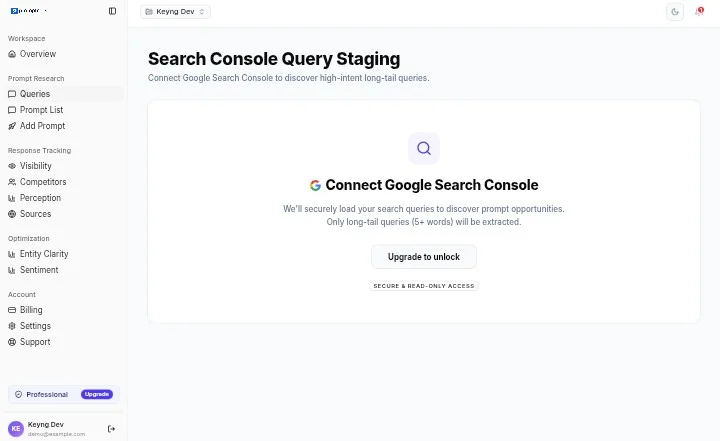
Filter Conversational Long-Tail Prompts
Raw GSC exports contain thousands of short navigational terms, brand name variations, single-word searches, typos.
None of these are useful for simulating how a founder or buyer actually asks a conversational AI for a recommendation.
The tracker filters the import to keep only queries longer than five words. These long-tail phrases, "best database for high-concurrency SaaS," "how to set up a white-label AI platform", represent genuine decision-intent language. They're the exact queries your prospects are using inside ChatGPT and Claude when they're ready to evaluate tools.
This automated filter eliminates the manual work of drafting tracking scenarios from scratch.
If your team would rather skip the build and start tracking immediately, PromptRank comes pre-configured with this pipeline out of the box. Our custom development services can also wire a private deployment to your existing infrastructure.
Track Daily Conversational Queries
Once your prompt library is populated, you need an infrastructure layer that can run all of them without blocking your application server.
This is where most DIY setups break. Single-threaded API polling creates rate-limit collisions, orphaned jobs, and missing results when one model times out.
Scale Audits with Async Workers
Every tracking job follows the same four-step execution sequence once it's pulled from the Redis queue:
- Live search grounding: The worker queries Serper.dev to retrieve the current top 10 search results for that prompt. This step replicates how Perplexity and ChatGPT Search construct their own context before generating answers.
- Parallel model dispatch: The grounded prompt and search context are sent simultaneously to ChatGPT, Claude, Gemini, Grok, and Perplexity via the OpenRouter API gateway.
- Mention detection: Each model response is parsed for domain citations, brand name references, and recommendation language.
- Result storage: Detected mentions, rank positions, and raw response text are written to PostgreSQL and linked to the originating prompt.
BullMQ manages job distribution across worker threads, so a slow response from one model doesn't delay the others. Failed jobs retry automatically with exponential backoff.
Store Results in PostgreSQL
The relational schema ties everything together across three core tables.
| Table | Key Columns | Purpose |
|---|---|---|
projects |
id, domain, competitors |
Tracks each monitored domain and its rival brands |
prompts |
id, query_text, source |
Stores every long-tail query imported from GSC or CSV |
scan_results |
position, mentions, raw_output |
Logs each model's response, mention status, and rank position |
Storing results locally gives your team direct SQL access to the raw data, no locked exports, no SaaS dashboard credit limits, and no third-party data-sharing agreements.
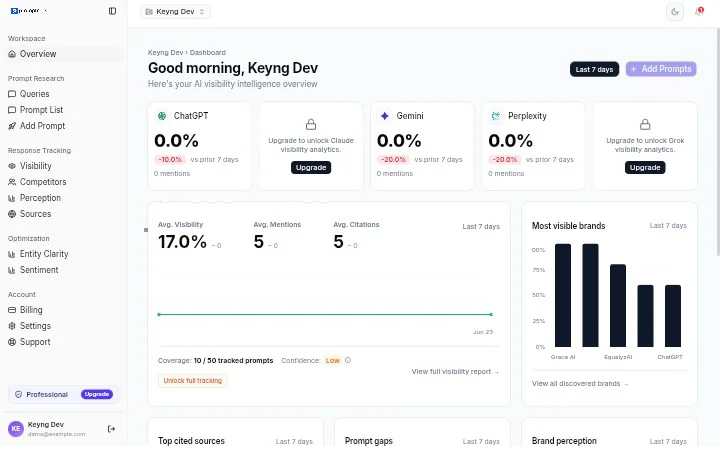
This architecture is what powers PromptRank's scan engine. Clients running 5,000 weekly prompts across five models see per-run costs under $150 per month at raw OpenRouter rates, compared to $1,000+ monthly for proprietary enterprise trackers with the same query volume.
Map Sentiment Trends Contextually
Raw mention counts tell you whether AI models are citing you.
Sentiment analysis tells you whether those citations are helping or hurting.
We encountered this pattern with a B2B SaaS client in the project management space. Their brand appeared in ChatGPT responses at a reasonably high frequency. Inbound lead quality was declining. When we ran sentiment classification against their scan results, the problem was immediately visible: the AI was consistently qualifying their platform as "better suited for large enterprise teams," which was steering SMB buyers toward simpler alternatives.
The fix wasn't more citations. It was correcting the contextual framing in the sources AI models were using as references.
Run Sentiment Radar Analysis
After each scan completes, the raw model output passes through a secondary classification step.
A lightweight text-classification model reads each response and extracts the specific attributes it associates with your brand. Each attribute gets tagged as Positive, Neutral, or Negative.
The output looks like this in practice:
| AI Response Extract | Extracted Attribute | Sentiment |
|---|---|---|
| "recommended for complex enterprise integrations" | Complex Integrations | Neutral |
| "pricing is steep for early-stage teams" | High Cost | Negative |
| "strong API documentation and developer support" | Developer-Friendly | Positive |
Running this classification weekly surfaces perception shifts before they compound into pipeline problems. If a software update changes how AI models describe your product, you'll catch it before your sales team does.
Render Perceived Attribute Treemaps
The classified attributes flow into an interactive treemap on the PromptRank dashboard.
Attributes cluster by frequency and sentiment, so the most-mentioned positive and negative associations sit prominently in the visual. A developer can immediately see if their product is being framed as "Developer-Friendly" versus "High Latency" without sorting through raw text exports.
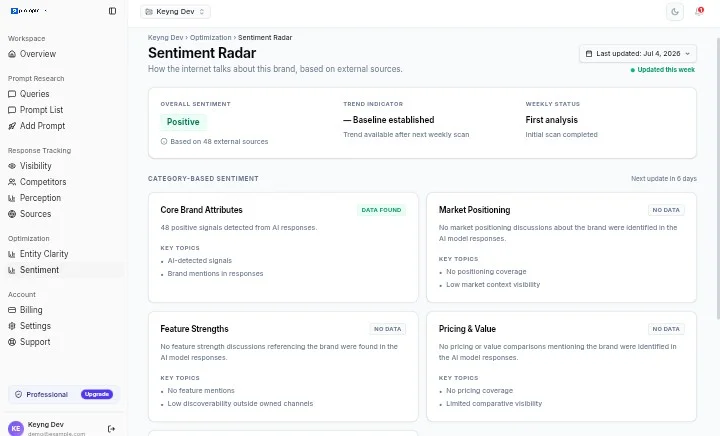
This visual layer converts a data pipeline into a decision-making tool. When the treemap shifts, you know exactly which attribute to address in your content and where the AI is picking up the framing.
Benchmark Competitor Rank Positions
Tracking your own brand visibility is useful.
Knowing which queries your competitors own, and which AI models prefer them, is the intelligence that drives actual content strategy.
Compare Recommendations Against Rivals
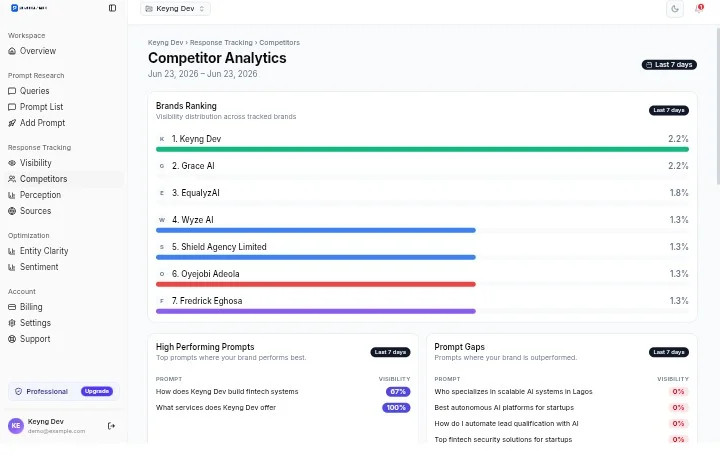
Every tracking job runs competitor domain detection in parallel with your own brand scan.
When a competitor brand appears in a model response, the system logs the mention, the model that surfaced it, and the query that triggered it. This data accumulates into a conversational Share of Voice (SOV) trendline for each competitor.
The comparison table below illustrates why owning the tracking infrastructure changes the cost picture entirely:
| Metric | Self-Hosted Tracker (BYOK) | Enterprise SaaS Tracker |
|---|---|---|
| Monthly Base Fee | $0, no subscription | $1,000/month minimum |
| API Costs | Raw OpenRouter rates only | Bundled into credit limits |
| Query Volume | Unlimited | Capped by plan tier |
| Data Ownership | 100% in your PostgreSQL instance | Locked in vendor database |
| Custom Integrations | Open plugin architecture | Not available |
Identify Conversational Mention Gaps
The most actionable output from competitor tracking is the Prompt Gap report.
A Prompt Gap is any query where a competitor was recommended and your brand was absent. The system automatically surfaces which external sources, Reddit threads, G2 reviews, analyst comparisons, the AI used as citations in those competitor recommendations.
That's your roadmap. Instead of trying to optimize for thousands of keywords broadly, your team can focus on getting cited by the exact publishers AI models are already trusting for these queries.
This is the core workflow behind generative engine optimization. For deeper context on building a full LLM citation tracker or a custom AI mention tracking pipeline on top of this architecture, our engineering team can scope a private deployment.
Conclusion
The AI search era doesn't reward the brands with the best traditional SEO.
It rewards the brands that show up consistently in the sources AI models trust, and who have the data infrastructure to know when they don't.
We built PromptRank to give our clients exactly that visibility, at raw infrastructure costs instead of locked SaaS pricing.
Whether you want to deploy a private self-hosted instance or explore PromptRank's pre-built dashboard, our custom development services cover architecture, deployment, and ongoing engineering support. Review the full product capabilities on the PromptRank product page to see what's included.
Frequently Asked Questions
How is this different from Google rank tracking?
Traditional rank trackers scrape search result pages to locate your URL position. A ChatGPT search rank tracker queries AI language models directly, parsing conversational answers to measure your brand's Share of Voice, not your page rank.
What does self-hosted tracking actually cost?
Tracking 1,000 prompts across five models weekly runs approximately $45 per month in raw API costs via OpenRouter and Serper.dev. Enterprise SaaS trackers with equivalent volume typically run $500 to $1,000 per month with restrictive credit caps.
Do AI crawlers require special structured markup?
Yes. Correct JSON-LD schema markup improves entity clarity, making it easier for AI models to recognize your brand, associate it with the right attributes, and surface it accurately in recommendations.
Can this run on serverless infrastructure?
No. The pipeline relies on persistent BullMQ background queues and scheduled cron loops. It must run on a Linux VPS, DigitalOcean, AWS EC2, or equivalent, with dedicated Redis and PostgreSQL instances. Our $150 VPS Installation Plan covers the full server setup.