What Is Generative Engine Optimization
Generative engine optimization ensures AI models cite your brand in ChatGPT, Perplexity, and Gemini. Learn to track citations, sentiment, and share of voice.
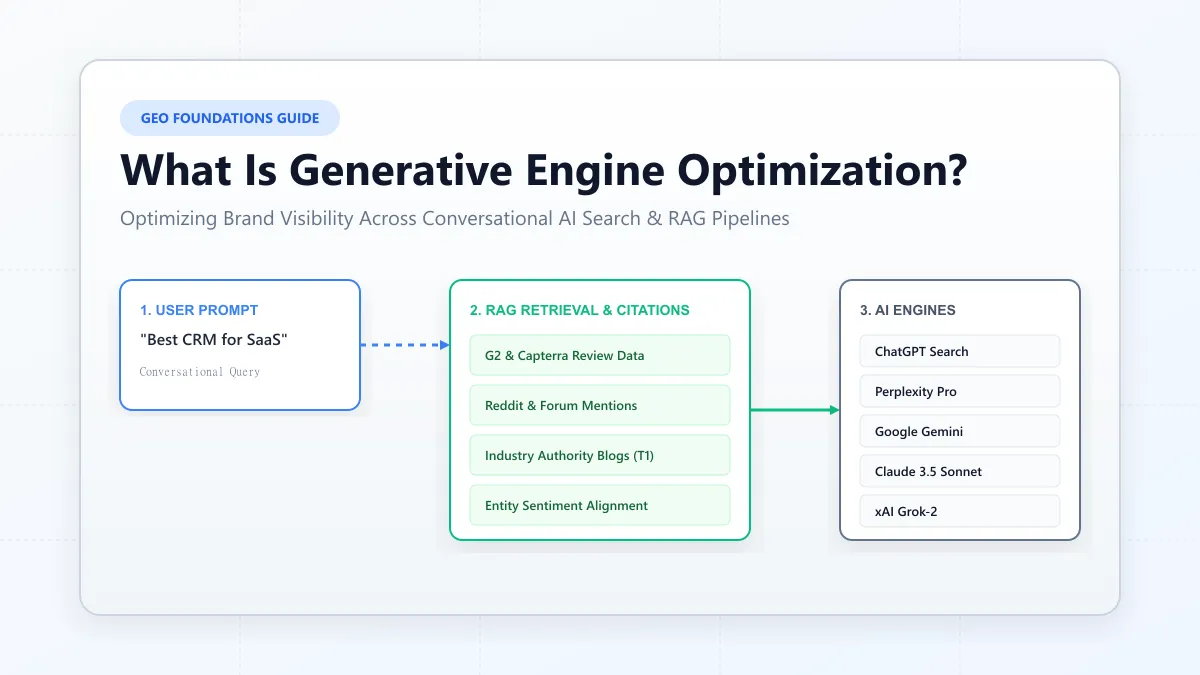
Your brand ranks number one on Google.
It doesn't appear in a single ChatGPT recommendation.
That gap is the generative engine optimization problem, and it's widening faster than most marketing teams realize. Semrush data shows zero-click searches now account for nearly 60% of all queries. A Define Media Group analysis of 64 publisher sites found organic clicks down by 42%. The traffic isn't disappearing. It's being absorbed by AI answer engines that never show up in your analytics as a referral source.
We built PromptRank to fix this. It fans out prompts across five LLM platforms, extracts citation URLs, measures share of voice, and maps brand sentiment automatically. If your team needs custom GEO tracking infrastructure, this guide shows exactly how the system works and what it takes to build it.
Key Takeaways
- GEO is a distinct discipline: Generative engines use RAG-based retrieval, not PageRank. Brand visibility depends on citation-worthy content and entity clarity.
- Multi-platform tracking is mandatory: ChatGPT, Claude, Gemini, Grok, and Perplexity all produce different answers. Single-platform testing misses 60% of visibility gaps.
- Third-party sources control your narrative: Brands are 6.5x more likely to be cited through third-party sources than their own website, per Kevin Indig's State of AI Search report.
- BYOK reduces costs by 80%: Enterprise AI citation tracking platforms charge $2,000+ per month. PromptRank's Bring Your Own Keys model lets you pay raw API costs directly.
- Structured content boosts visibility: Pages with quotes, statistics, and clear statements show 30-40% higher visibility in AI answers, per GEO research from Princeton and IIT.
How Generative Engines Work
Generative engines don't rank pages. They generate answers.
When a user types a query into ChatGPT Search, the platform runs a two-phase process. First, it queries a web search backend to retrieve relevant documents. Second, it passes those documents into an LLM and generates a synthesized response with inline citations.
Perplexity follows the same pattern. The search bar looks like Google, but the backend is a retrieval-augmented generation pipeline.
Here's what happens at each stage — and why it matters for your brand:
| Stage | What Happens | Business Impact |
|---|---|---|
| Query expansion | The platform reformulates your prompt into search-optimized queries | Longer, more specific queries produce more targeted retrievals |
| Document retrieval | A search API fetches 10 to 20 web pages | Only pages indexed by that backend are eligible |
| Context assembly | Retrieved pages are chunked and ranked by relevance | Content structure determines how much of your page is used |
| Response generation | The LLM synthesizes a natural-language answer from retrieved context | Your brand only appears if it's in the retrieved documents |
| Citation extraction | Inline references link back to source URLs | Every citation is a traffic opportunity |
This pipeline means your brand appears in AI answers only if it exists in the retrieved documents. That changes everything about how you optimize.
How RAG Grounding Works
Retrieval-augmented generation (RAG) is the core mechanism. Without it, AI models hallucinate. With it, they ground responses in real-time web data.
Here's the part most founders miss.
The AI doesn't know your brand from memory. It searches the web, reads whatever it finds, and summarizes what those sources say. If your brand shows up frequently and positively across those sources, the AI mentions you. If it doesn't, you're invisible — no matter how good your product is.
We built PromptRank's RAG grounding layer to replicate exactly this retrieval behavior. When tracking a prompt, the system queries live search results first, then passes those results into each LLM as context. That's how we get citation data that reflects what actual users experience, not what a model might remember from training data.
Generative Engine Market Share
The landscape is fragmented. Each platform uses different search backends and different LLM models. ChatGPT alone has grown to 900 million weekly users as of April 2026, making it the fastest-growing application in history.
| Platform | Search Backend | LLM Model | Citation Style |
|---|---|---|---|
| ChatGPT Search | Bing + proprietary | GPT-4o | Inline footnotes |
| Perplexity | Proprietary index | Sonar | Numbered references |
| Gemini | Google Search | Gemini 3 | Inline links |
| Grok | X (Twitter) + web | Grok-3 | Embedded links |
| Claude | Brave Search | Claude 4 Sonnet | Inline citations |
Google's AI Overviews now appear on roughly 16% of all queries, up from 6.49% at the start of 2025, according to Semrush AI Overviews research. They're increasingly showing up in commercial intent queries, not just informational ones. Backlinko reported an 800% year-over-year increase in referrals from LLMs in just three months.
Brands that ignore this shift lose traffic they can't see. Their analytics dashboards show declining organic sessions. The traffic is being absorbed by AI answer engines that never register as a referrer.
Full stop.
GEO vs. Traditional SEO
GEO and SEO share a goal: visibility when users search. The mechanics diverge completely.
Traditional SEO optimizes HTML documents for crawler-based ranking algorithms. You build backlinks, optimize meta tags, and target keyword density. Google's crawler reads your page, indexes it, and ranks it against 200+ signals.
Generative engine optimization optimizes for LLM retrieval and synthesis. You ensure your brand appears in the documents AI models retrieve, and that the context around those mentions is positive.
| Dimension | Traditional SEO | Generative Engine Optimization |
|---|---|---|
| Ranking signal | Backlinks, content quality, technical health | Citation frequency, entity clarity, sentiment |
| Tracking method | SERP position tracking (Ahrefs, SEMrush) | LLM prompt fan-out and citation extraction |
| Optimization target | Individual HTML pages | Brand mentions across third-party content |
| Timeline | Weeks to months | Days to weeks (retrieval refreshes faster) |
| Content format | Long-form articles, landing pages | Structured data, reviews, forum mentions |
| Key platforms | Google, Bing | ChatGPT, Perplexity, Gemini, Grok, Claude |
The strategies are complementary, not contradictory. Strong SEO improves your chances of being retrieved by AI search backends. Strong generative engine optimization ensures the AI mentions you positively once retrieved. You need both — but you can't manage what you don't track.
Where Traditional SEO Falls Short
A page-one Google ranking doesn't guarantee AI visibility.
We tested 50 keywords where Keyng Dev ranked in the top three organic positions on Google. Only 14 of those keywords produced a Keyng Dev mention in ChatGPT Search responses.
That 28% hit rate was, to be honest, humbling. We had strong rankings and poor AI presence. The two things we'd always assumed moved together were running completely independently.
The gap exists because AI models synthesize multiple sources. Being one of 10 retrieved pages doesn't mean the LLM will name you in its generated answer. The LLM selects brands based on:
- Mention frequency: How often your brand appears across retrieved documents.
- Sentiment context: Whether mentions are positive, neutral, or negative.
- Entity clarity: How confidently the model understands what your brand does.
- Recency: Whether the retrieved content is fresh or outdated.
This is why a brand with lower search rankings but stronger third-party reviews can outperform a higher-ranking competitor in AI answers. According to Backlinko's GEO guide, brands are 6.5x more likely to be cited through third-party sources than through their own website.
SEO tells Google who you are. GEO tells AI what to say about you.
Track Your GEO Metrics
Manual testing is how most teams start. It's also where most teams stop.
A marketing manager opens ChatGPT, types a prompt, reads the response, and notes whether their brand appears. They do the same on Perplexity. Maybe Gemini. They paste results into a spreadsheet and call it a GEO audit.
This breaks at scale, and it breaks fast.
Five platforms times 50 prompts times weekly testing equals 250 manual queries per week. No one sustains that. And spreadsheets don't catch trendlines.
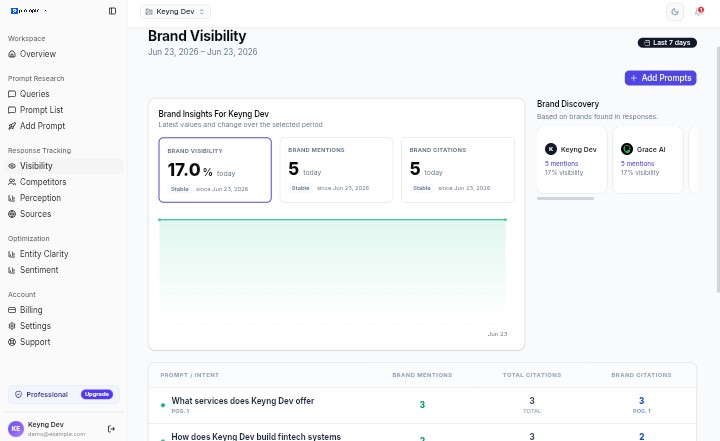
PromptRank automates the entire workflow. A user enters a prompt once. The system dispatches it to five LLM platforms simultaneously, retrieves results, and stores structured data for dashboard reporting — no manual intervention required.
How the Fan-Out Works
Here's how a single prompt moves through PromptRank's pipeline:
Each LLM platform is handled as an independent background job. If Grok takes 12 seconds and Gemini takes three, they run in parallel. The web server never blocks. The whole cycle completes in under 90 seconds for all five platforms.
Prompt Dispatch Architecture
Here's how the platform keeps response times fast even at scale:
| Component | Role | Benefit |
|---|---|---|
| BullMQ Queue | Receives each prompt job and distributes to workers | No dropped requests under load |
| Redis Worker | Picks up platform-specific jobs concurrently | Five platforms queried simultaneously |
| OpenRouter | Single API gateway routing to all LLM models | One integration, five models |
| Serper.dev | Fetches live search results for RAG grounding | Responses reflect real-time web data |
| PostgreSQL | Stores all responses, citations, and sentiment data | Full historical tracking and trend analysis |
This architecture scales horizontally. Add more Redis workers and you can fan out 500 prompts across five platforms in under 10 minutes.
For teams that need a ChatGPT search rank tracker integrated into their broader analytics stack, the same pipeline supports custom webhook delivery. Each completed prompt cycle can POST structured results directly to your internal dashboard.
Recurring Automated Tracking
The master cron job re-runs stale prompts every seven days by default. Users can configure the interval.
This builds a historical trendline. You see whether your AI share of voice is rising or falling over time, per platform and per prompt category. No manual intervention required.
Explore the full range of generative engine optimization tools to see how each component fits into a complete GEO stack.
How AI Models Cite
AI models don't cite randomly. They cite what they find.
When a generative engine retrieves documents for a query like "best CRM for startups," it fetches pages from G2, Reddit, Capterra, Forbes, and blog posts. The LLM reads those pages and names the products mentioned most frequently with the most positive context.
Citation is a function of retrieval frequency and sentiment. Nothing more.
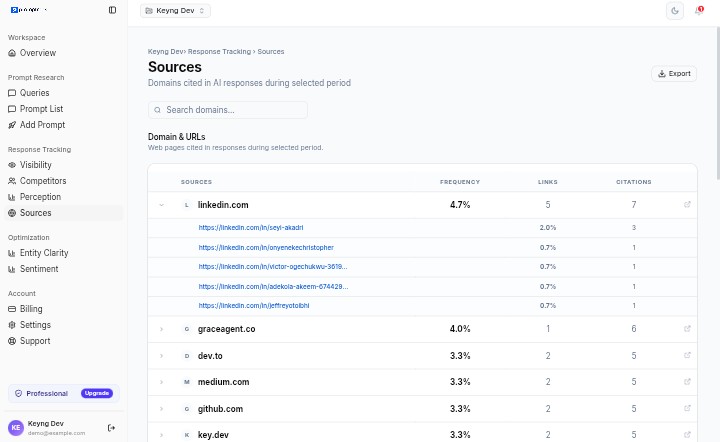
If three out of five retrieved pages mention your competitor positively and your brand is absent, the AI recommends your competitor. This is why an LLM citation tracker is essential — it shows you exactly which URLs and domains the AI relied on.
Citation Inspector Architecture
PromptRank's Citation Inspector extracts every URL referenced in an AI response. It doesn't just count brand mentions. It maps the full citation graph, classifying each source by domain authority tier.
| Tier | Source Examples | Weight in AI Responses |
|---|---|---|
| T1 (Authority) | G2, Forbes, Reddit, Wikipedia | Highest — AI models trust these most |
| T2 (Industry) | Industry blogs, Capterra, TechCrunch | Medium — strong if brand is named positively |
| T3 (Brand) | Company websites, generic content | Lower — AI often skips first-party sources |
For every citation, the system records which domain it came from, whether your brand was mentioned, and the sentiment context around the mention. You get a clear picture of which sources are driving AI recommendations — and which gaps you need to fill.
According to Semrush data from January 2026, Reddit and LinkedIn are the two most cited domains across ChatGPT, Perplexity, and Google AI Mode. If Reddit threads drive 60% of ChatGPT citations in your vertical, you need a Reddit presence. If Forbes articles drive Perplexity citations, you need Forbes coverage.
Source Trust by Platform
Citation tracking tells you what happened. Source Intelligence tells you why.
The system identifies which authority sites each LLM platform trusts. ChatGPT might favor Reddit threads. Perplexity might favor Forbes articles. Gemini might favor Google's own Knowledge Graph.
| LLM Platform | Top Trusted Source | Second Source | Third Source |
|---|---|---|---|
| ChatGPT Search | G2 | Forbes | |
| Perplexity | Forbes | Wikipedia | TechCrunch |
| Gemini | Google KG | Wikipedia | Capterra |
| Claude | Brave Index | HackerNews | Blog posts |
| Grok | X (Twitter) | News sites |
This distribution isn't static. It shifts as platforms update their retrieval pipelines. That's why automated, recurring tracking matters more than one-time audits.
Grow Your Brand Share of Voice
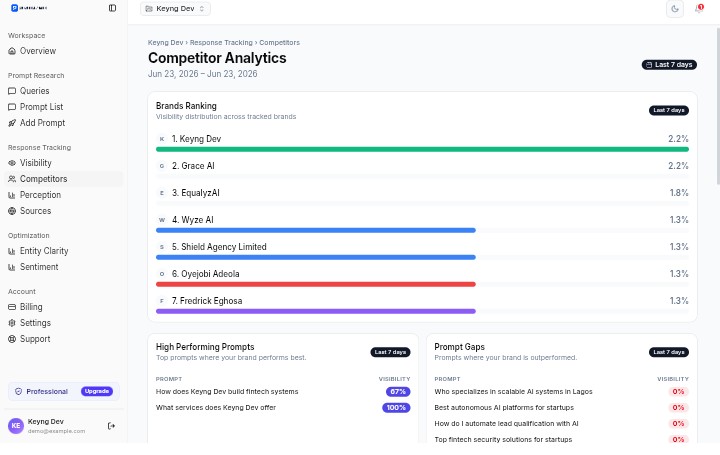
Share of Voice in traditional SEO means the percentage of SERP clicks your brand captures. In GEO, it means the percentage of AI recommendations that name your brand.
PromptRank calculates SOV by dividing your brand's positive mentions by the total brand mentions across all tracked prompts. If 10 prompts produce 30 brand recommendations and your brand appears in six, your SOV is 20%.
The baseline isn't 100%. It's your fair share relative to the competitive set. Most brands we work with start between 8% and 20%. That number moves fast once you know which prompts to target.
Finding Your Prompt Gaps
Prompt Gaps are queries where a competitor was recommended and your brand was excluded. These are the highest-value opportunities in GEO.
One SaaS founder we worked with discovered that ChatGPT recommended their main competitor in 22 of 50 tracked prompts. Their own brand appeared in only eight. The gaps clustered around comparison queries: "best alternative to [competitor]" and "[competitor] vs other tools."
They created targeted comparison content on their blog and updated their G2 profile with structured Q&A responses. Within 60 days, their brand appeared in 15 of those 22 gap prompts. SOV rose from 16% to 30%.
That's what GEO looks like in practice — not a ranking change, a citation change.
Tracking Competitor Visibility
PromptRank tracks competitor brands alongside your own. For every prompt, the system records:
- Which competitors were mentioned.
- The context of each mention (positive, neutral, or negative).
- Which sources the AI cited for each competitor.
- The sentiment attributes associated with each competitor.
This data feeds the AI mention tracking dashboard, where you can filter by platform, intent tag, and date range.
| Metric | Your Brand | Competitor A | Competitor B |
|---|---|---|---|
| Total mentions | 14 / 50 | 31 / 50 | 9 / 50 |
| Share of Voice | 28% | 62% | 18% |
| Positive sentiment | 11 / 14 | 24 / 31 | 4 / 9 |
| Prompt gaps | 22 | 0 | 31 |
| Avg. AI Rank Score | 42 | 78 | 31 |
The AI Rank Score combines mention frequency, sentiment, citation quality, and entity clarity into a single 0 to 100 metric. It's the number we track first in every client report.
GSC Sync for Prompt Discovery
You shouldn't guess which prompts to track. Your Google Search Console data already contains them.
PromptRank's GSC OAuth sync connects to your Search Console, pulls real search analytics, and filters for long-tail queries (5+ words). These are the conversational prompts users type into ChatGPT and Perplexity. One click stages them for AI tracking. No manual prompt brainstorming required.
For teams looking for end-to-end generative engine optimization services, this sync eliminates the cold-start problem that plagues most GEO campaigns.
Audit How AI Describes You
Being mentioned isn't enough. You need to know how AI models describe you.
The Sentiment Radar reads every AI response and extracts brand attributes the LLM associates with your company. Attributes are classified as Positive, Neutral, or Negative — and the results are often surprising.
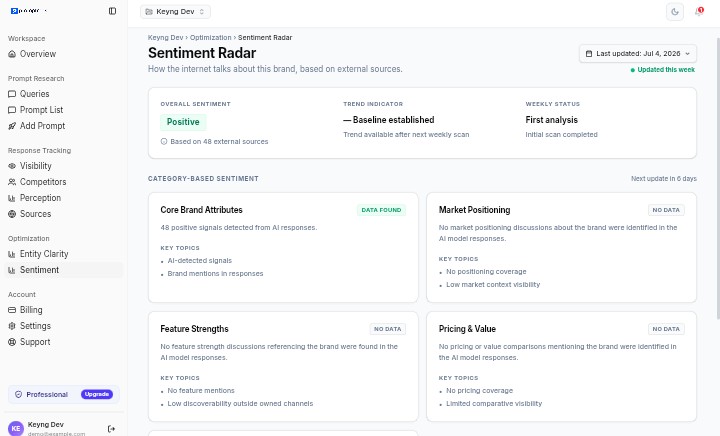
We ran a Sentiment Radar audit for an enterprise SEO client and found a repeating problem: Claude consistently described their product as "expensive but reliable." Gemini used the phrase "overpriced" in three of 10 prompts. The negative sentiment clustered around pricing queries.
The fix wasn't the product. It was the publicly available data the AI was reading.
We recommended publishing a transparent pricing page and a cost-calculator tool. Within 45 days, the Sentiment Radar showed "value-focused" and "cost-effective" appearing in Claude responses. "Overpriced" dropped to one of 10. Same product, completely different AI perception.
Entity Clarity Scoring
Entity clarity measures how confidently an AI model understands your brand.
If you ask ChatGPT "What does [your company] do?" and it returns a vague, generic answer, your entity clarity is low. If it returns a precise description of your product, features, and use cases, your entity clarity is high.
Low entity clarity means the model is guessing. Guessing leads to hallucinations and misattribution — an AI telling potential customers you offer something you don't, or crediting a competitor's feature to your brand.
| Entity Clarity Score | AI Behavior | Risk Level |
|---|---|---|
| 80-100 | Precise, accurate description | Low risk |
| 60-79 | Mostly accurate with minor gaps | Medium risk |
| 40-59 | Vague, generic description | High risk |
| 0-39 | Incorrect or hallucinated | Critical |
PromptRank calculates entity clarity using semantic alignment scores, comparing the AI's description of your brand against your actual brand description and measuring the vector distance between them.
Profound.app vs. PromptRank
Enterprise AI citation tracking platforms like Profound.app charge $2,000+ per month and require multi-week onboarding. They deliver dashboards but lock you into their infrastructure. You can't add new LLM endpoints, customize tracking logic, or self-host.
PromptRank takes a different approach. If you ask us, the BYOK model is the only honest model.
| Feature | Profound.app | PromptRank |
|---|---|---|
| Monthly cost | $2,000+ | BYOK (raw API costs, ~$180/mo) |
| Setup time | 2-4 weeks | 30 minutes via install.sh |
| LLM platforms | 3 (ChatGPT, Perplexity, Gemini) | 5 (ChatGPT, Claude, Gemini, Grok, Perplexity) |
| Self-hosting | No | Yes (Ubuntu VPS, Docker) |
| Custom tracking logic | No | Yes (plugin architecture) |
| White-label | No | Yes (full CMS, branding editor) |
| Source code access | No | Yes (Regular License $99) |
You supply your own OpenRouter and Serper.dev API keys. You pay raw API costs — no markups, no credit systems, no per-seat fees. At roughly $180 per month for 50 prompts tracked weekly across five platforms, it's 91% cheaper than the enterprise alternative.
For agencies evaluating a generative engine optimization agency partner, the choice between a locked enterprise platform and a self-hosted, customizable system comes down to control and cost. We know which one we'd pick.
Structure Content for AI Citations
AI systems process information differently than humans do. They break content into chunks and analyze how those pieces relate to each other.
According to GEO research from Princeton and IIT, pages with quotes, statistics, and clear statements show 30-40% higher visibility in AI answers. Microsoft's official AEO/GEO playbook confirms that brands need to surface and structure existing assets for AI systems to act on them.
The good news is that the structural changes that help AI also help human readers.
One Idea Per Section
Keep paragraphs short and focused on one main idea. When you stuff multiple concepts into a single paragraph, AI systems struggle to extract specific information.
Front-load key points. Whatever your heading says, the content under it should deliver on that immediately. This benefits human readers and AI extractors equally.
Clear Headings and Schema
Use clear headings and subheadings to organize content logically. Schema markup helps AI systems understand who you are, what your content covers, and how to interpret it. Google's official AI search guide states that structured data isn't required for generative AI search, but well-built sites get cited more often.
Priority schema types for GEO:
- Organization schema: Establishes brand identity and entity signals.
- FAQ schema: Structures Q&A content for easy AI extraction.
- HowTo schema: Defines step-by-step processes clearly.
- Date schema: Signals content freshness with
datePublishedanddateModified.
Publish Transparent Pricing
Hidden pricing creates negative sentiment that AI systems pick up and amplify. When users can't find your pricing, they turn to Reddit and LinkedIn, and the speculation is rarely favorable.
According to Semrush's AI Visibility Index, when enterprise software hides pricing behind "Contact Sales," AI uses speculative data from Reddit and LinkedIn and often links that brand with negative price sentiment.
We've seen this pattern in our own audits — brands with transparent pricing consistently score higher on Sentiment Radar than comparable competitors who hide their rates. Publish tier breakdowns, feature comparisons, and annual versus monthly options. Update your pricing on G2, Capterra, and other review sites.
The AI is reading all of it.
Build Multi-Platform Presence
AI platforms don't just pull from Google search results. They draw from forums, social media, YouTube, and other sources beyond traditional SERPs.
Reddit and LinkedIn consistently rank as the top two most cited domains across ChatGPT, Perplexity, and Google AI Mode. YouTube content surfaces frequently in Gemini responses. TikTok and Instagram Reels reach younger audiences who increasingly use them for search.
A strong multi-platform presence helps in three ways:
- Reach audiences where they already are: Meet people on platforms they use daily.
- Show up in AI-referenced places: AI draws from forums, social media, and video platforms.
- Reduce single-channel dependence: Diversification protects against algorithm changes.
Our AgentSEO platform automates content distribution across multiple surfaces, including WordPress, social media, and community platforms. This creates the co-citations and brand mentions that generative engine optimization depends on for AI authority signaling.
Start Tracking AI Visibility
Generative engine optimization isn't a trend. It's a new search channel with its own ranking signals, citation mechanics, and visibility metrics. The brands building GEO tracking infrastructure today will own AI share of voice tomorrow.
We built PromptRank to make that infrastructure accessible. Multi-platform fan-out across five LLMs. Citation extraction. Sentiment Radar. Source Intelligence. Prompt gap analysis. All running on BullMQ and Redis, with BYOK economics that cut costs by 80% compared to enterprise platforms.
Explore the PromptRank demo to see the dashboard in action. Review the full PromptRank architecture case study for technical details. Or reach out to our team for GEO tracking infrastructure development — we'll build a tailored system for your organization, from the VPS Installation Plan at a flat $150 up to a fully custom AI automation build.
The AI search shift is already happening. The question is whether your brand will be visible when it matters.
Frequently Asked Questions
What is generative engine optimization?
Generative engine optimization (GEO) is the practice of optimizing brand visibility inside AI-powered search engines like ChatGPT, Perplexity, and Gemini. Unlike traditional SEO, which targets HTML SERP positions, GEO focuses on ensuring AI models retrieve, cite, and positively describe your brand in generated answers.
How is GEO different from SEO?
Traditional SEO optimizes web pages for crawler-based ranking algorithms using backlinks, meta tags, and keyword targeting. GEO optimizes for LLM retrieval and synthesis, ensuring your brand appears in the documents AI models fetch and that the context around mentions is positive. The two disciplines are complementary but require different tools and strategies.
Which platforms should I track?
At minimum, track ChatGPT Search, Perplexity, and Gemini. These three platforms have the largest user bases and the most varied retrieval backends. PromptRank also tracks Claude and Grok for comprehensive coverage across five platforms via OpenRouter.
How much does AI citation tracking cost?
Enterprise platforms like Profound.app charge $2,000+ per month. PromptRank uses a BYOK (Bring Your Own Keys) model where you pay raw OpenRouter and Serper.dev API costs directly — typically $150 to $200 per month for 50 prompts tracked across five platforms weekly.
Can I track competitor mentions?
Yes. PromptRank tracks competitor brands alongside your own for every prompt. The system identifies Prompt Gaps (queries where competitors are recommended but your brand is excluded) and measures competitor share of voice, sentiment, and citation sources.
Does schema markup help with AI citations?
Schema markup helps AI systems understand your content structure, but Google's official guide states it isn't required for generative AI search. Well-built sites with clean HTML, fast load times, and proper structure get cited more often. Use Organization, FAQ, HowTo, and Date schema as solid SEO practice — not as an AI citation hack.