The Best n8n Alternative for SaaS
Learn how custom-coded workflow engines with Redis queues and BullMQ outperform n8n cloud subscriptions for high-volume SaaS operations.
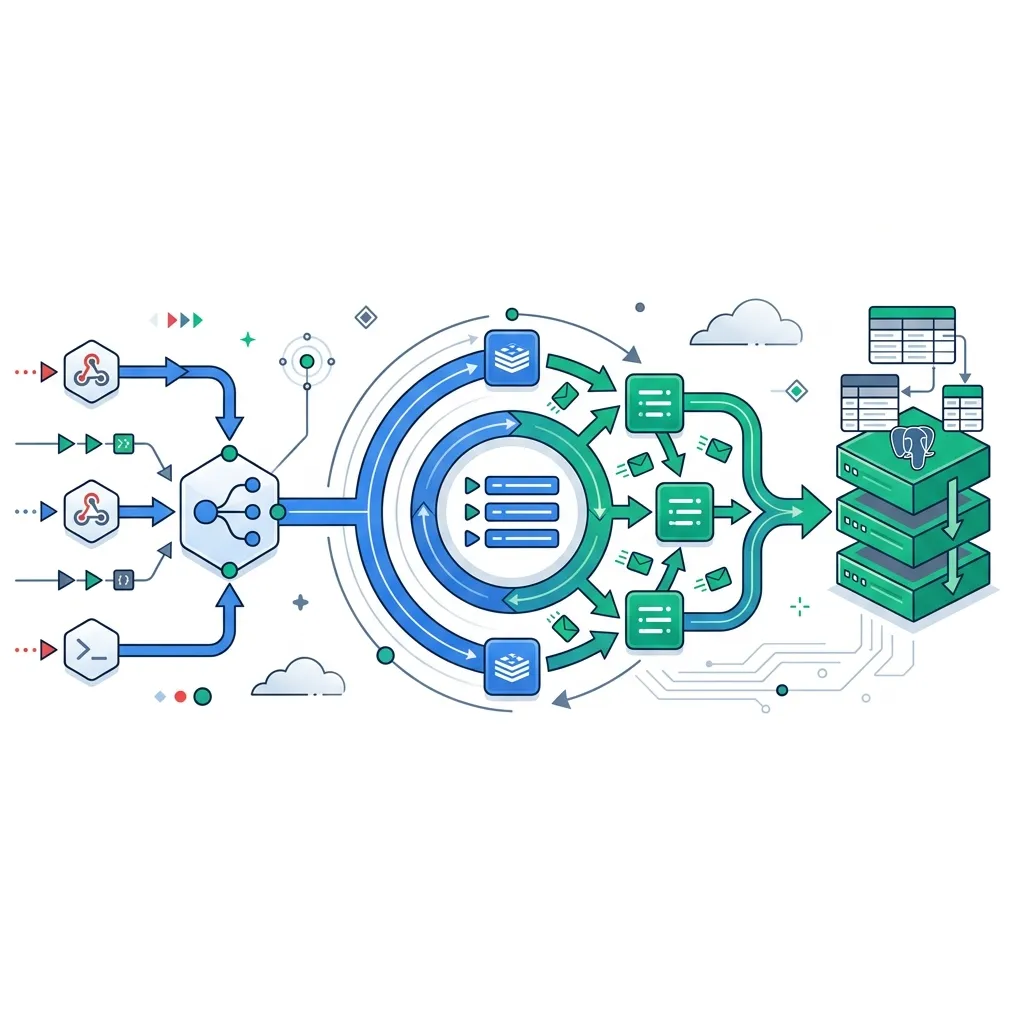
Your workflow queue backs up at 3 PM every Tuesday.
The n8n Cloud dashboard shows 14,000 executions queued, your concurrent workflow cap is five, and Stripe webhooks are timing out. You are paying $200 a month for the privilege.
System architects know this bottleneck. Hosted workflow tools impose rate limits that break at scale, and their per-execution pricing punishes you for success. The real n8n alternative is not another SaaS subscription — it is a custom-coded workflow engine running on your own VPS with Redis queues, BullMQ workers, and zero artificial caps. We build these systems for SaaS founders every week through our custom development services.
We've shipped 20+ products and architected high-concurrency systems handling 100k+ concurrent transactions — and replacing fragile visual workflows with robust code is one of our core specializations.
Key Takeaways
- Cost ceiling eliminated: A custom Redis + BullMQ engine on a $12/month VPS handles unlimited executions, compared to n8n Cloud's $200+/month for 50k executions.
- Concurrency control: BullMQ workers scale horizontally with configurable parallelism — eliminating vendor-imposed workflow caps.
- Data residency: Webhook payloads stay entirely on your infrastructure, ensuring full compliance with zero third-party exposure.
- Code-level RAG: Custom engines integrate retrieval-augmented generation pipelines natively, skipping visual node serialization passes.
Why Cloud Workflow Subscriptions Fail
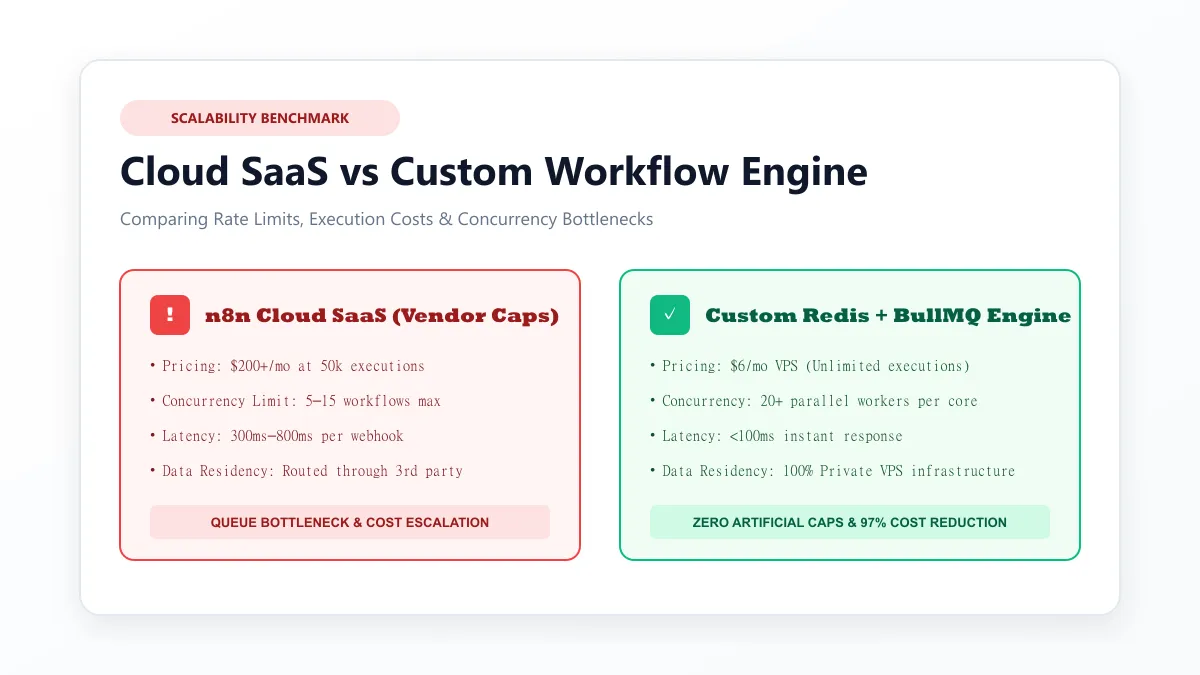
n8n Cloud charges per execution, not per server. That model works for side projects until real customer traffic arrives.
At 2,500 executions per month, the Starter plan at $20 feels reasonable. At 50,000 executions, you're on the Pro plan paying $200 monthly. At 100,000, the bill exceeds $400. The pricing scales linearly with your success, creating a tax on your growth.
One SaaS founder who hired us was processing customer onboarding webhooks through n8n Cloud. By month eight, his team was firing 40,000 executions per month across five concurrent workflows. His automation bill hit $180 — exceeding his entire database hosting infrastructure costs.
We migrated his pipeline to a custom BullMQ engine on a $12 VPS, cutting his monthly automation spend by 93%. The server handled the same 40,000 executions with minimal CPU utilization.
The execution cap is the second point of failure. n8n Cloud's Starter tier allows five concurrent workflows, while Pro allows 15. When Stripe sends 200 webhook events in a burst during subscription renewals, 15 concurrent workers process them in batches while the remaining 185 sit in queue. If your webhook endpoint doesn't respond within five seconds, Stripe retries, flooding your system with duplicate events.
Self-hosting n8n removes the pricing cap but inherits a structural limitation: the visual node graph itself. Every node acts as a JSON abstraction layer over code. Parsing a webhook payload through five nodes requires five serialization passes. A custom TypeScript handler processes that same payload in a single in-process pass with zero serialization overhead.
Building Custom Workflow Engines
A custom workflow engine isn't overly complex — it consists of an ingress endpoint, a persistent queue, and a worker pool with retry policies.
We build custom workflow engines using Next.js API routes for webhook ingress, Redis for pub/sub event channels, and BullMQ for persistent task queues. The entire stack runs inside Docker containers on a private VPS. No per-execution fees, no concurrent workflow caps, and no third-party data residency concerns.
If you're evaluating a custom software development company to build this architecture, the pattern is clean and predictable.
When a webhook arrives from Stripe or another provider, our API endpoint verifies the signature, pushes the job to BullMQ, and returns a 200 OK response to the provider in under 100 milliseconds.
Compare that to n8n Cloud, where the webhook travels to external servers, traverses the visual node graph, and returns — a round trip adding 300 to 800 milliseconds of latency per request.
Our worker pool then processes jobs asynchronously. A single worker container running BullMQ can execute 20+ jobs concurrently without missing a beat. Need to handle higher volume? Spin up a second worker container pointing at the same Redis instance. BullMQ handles distributed locking automatically so no job is processed twice.
How Redis Powers Queue Processing
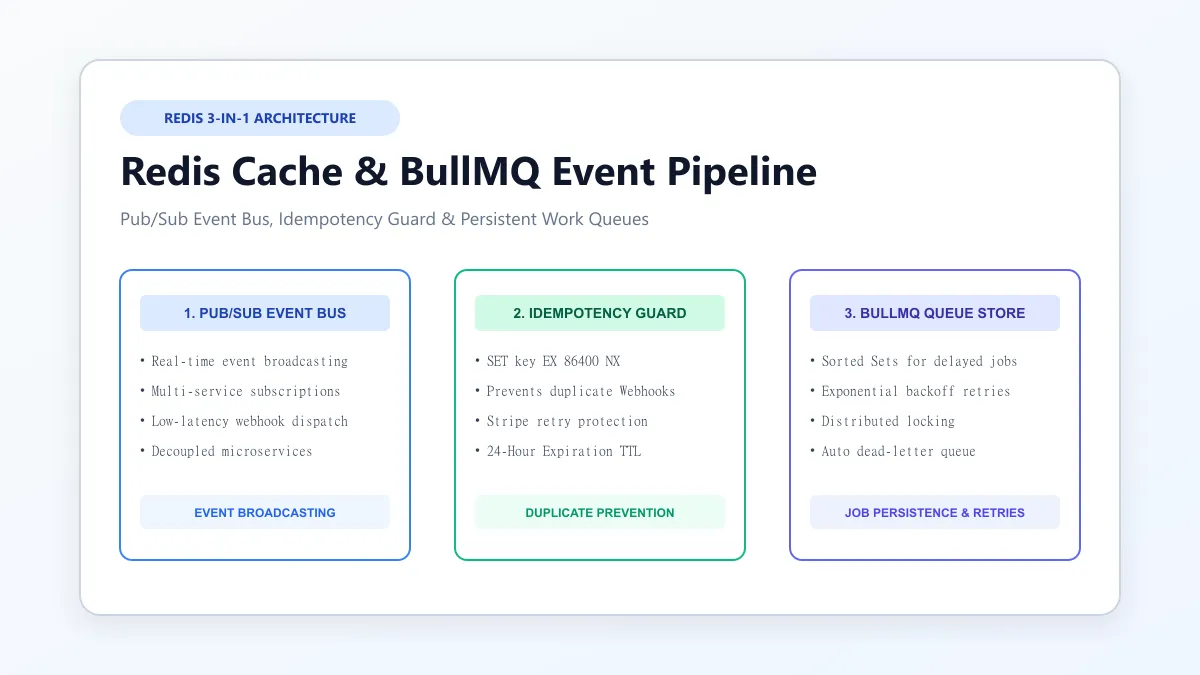
Redis is the backbone of a high-performance workflow engine, serving three distinct functions: pub/sub event bus, rapid cache layer, and BullMQ's persistence backend.
When a webhook arrives, the API route publishes an event to a Redis channel where subscribed services react in real time. The caching layer stores idempotency keys to prevent duplicate event execution, while BullMQ utilizes Redis sorted sets for delayed jobs and lists for active execution queues.
Using Redis key guards with atomic SET NX flags ensures that a given event key is written only if it doesn't already exist. If Stripe retries a webhook with an identical event ID, the guard detects the existing record and skips processing immediately, preventing duplicate charges or emails.
A fintech client came to us facing a compliance roadblock when auditors discovered their n8n Cloud workflows routed sensitive transaction webhooks through third-party cloud infrastructure. The auditors flagged it as a data residency violation under PCI-DSS standards.
Our team replaced the n8n pipeline with a self-hosted Next.js API route running on a private VPS. Webhook payloads containing transaction metadata never left their private network, and the compliance audit passed in two weeks.
That is the security advantage: your data never touches a third-party server.
For teams building AI-driven automation, an ai workflow builder with native RAG integration outperforms visual node workarounds. Custom engines query vector databases directly within the worker process, avoiding extra HTTP hops between visual nodes.
Handling High-Volume Webhook Bursts
High-volume webhook handling is where visual node builders fall apart and custom-coded engines excel.
A digital publishing team we worked with was attempting to publish 300 articles per day through n8n Cloud. Their workflow triggered on a schedule, fetched draft data, called an LLM API, and published to WordPress. n8n's five-concurrent-workflow cap meant 300 articles required six hours to complete. During peak publishing days, queues backed up and articles missed their scheduled windows.
We rebuilt their pipeline using a custom Redis queue paired with 20 parallel BullMQ workers. The same 300 articles processed in just 18 minutes. On high-volume days, the system handled over 3,000 articles without queue buildup.
The architectural comparison highlights the clear trade-offs:
| Feature | n8n Cloud (Pro) | n8n Self-Hosted | Custom Engine (keyngdev) |
|---|---|---|---|
| Execution limit | 50k/month | Unlimited (Server RAM) | Unlimited (Server RAM) |
| Concurrent workflows | 15 | Unlimited | Unlimited (BullMQ workers) |
| Cost at 50k execs/month | ~$200 | $12 VPS | $12 VPS |
| Webhook data residency | n8n servers | Your server | Your server |
| Retry strategy | Basic | Basic | Exponential backoff (BullMQ) |
| Custom RAG integration | Visual nodes | Visual nodes | Native TypeScript |
| Code auditability | JSON graph | JSON graph | Full source code |
| Latency per webhook | 300-800ms | 150-400ms | <100ms |
The performance metrics are straightforward. A $12 VPS running Redis and BullMQ outperforms a $200/month SaaS subscription on speed, reliability, and security.
If you need to hire nextjs developer talent to implement these webhook pipelines, we use battle-tested patterns. Next.js API routes, Redis pub/sub, and BullMQ workers are standard tools in our custom engineering projects.
Our deployment container setup includes two worker replicas, a Redis instance, and a PostgreSQL database. The complete environment runs on a standard VPS starting at our $150 VPS Installation Plan flat rate, and scaling horizontally requires just one command to add more worker replicas.
When to Choose Custom Over n8n
Custom workflow engines aren't necessary for every project. If you process under 1,000 executions per month and your workflows consist of simple API-to-API connections, n8n's free tier or Starter plan works fine. The visual builder saves setup time for non-technical teams.
However, if your business matches any of these criteria, a custom engine pays for itself within 30 days:
- You process more than 10,000 executions per month
- Webhook payloads contain sensitive or regulated customer data
- You require custom RAG pipelines or AI model integration in the workflow
- Your concurrent processing demands exceed n8n's tier caps
- You demand full source-code auditability of your automation logic
We have engineered custom workflow engines for SaaS startups, content platforms, and fintech agencies. The core architecture remains consistent: Redis for speed, BullMQ for reliability, Docker for portability, and Next.js for developer velocity. The result is an automation engine that costs less, runs faster, and never penalizes your business for scaling.
Conclusion
n8n is a capable tool for low-volume, visual workflow building. At scale, its per-execution pricing and concurrency limits create unnecessary friction. The definitive n8n alternative is a custom-coded engine running Redis, BullMQ, and Next.js on a private VPS — offering unlimited executions, zero per-action fees, and total data residency.
We build these custom engines for SaaS founders and growing businesses through our custom development services. If your automation bill is growing faster than your product revenue, contact our engineering team to replace it with a system you own outright.
Frequently Asked Questions
Is Self-Hosting n8n a Good Alternative?
Self-hosting n8n eliminates per-execution fees but retains the performance overhead of the visual node graph. You still contend with JSON serialization between nodes and limited native RAG integration options. A custom-coded engine provides complete TypeScript control, direct vector database access, and sub-100ms webhook response times.
How Much Does n8n Cloud Cost at Scale?
n8n Cloud's Pro plan costs approximately $200 per month for 50,000 executions. At 100,000 executions, monthly pricing exceeds $400. A custom engine deployed on a $12 VPS processes the same volume with no per-execution charges — bound only by server CPU and RAM limits.
Can Custom Workflow Engines Handle Retries?
Yes. BullMQ provides native support for exponential backoff, configurable retry attempts, dead-letter queues, and automatic job retention policies. The retry logic runs inside your code under your exact parameters rather than inside a vendor's black box.
Do I Need Redis for a Custom Workflow Engine?
Redis is highly recommended. It powers pub/sub event channels, persistent job storage for BullMQ, and idempotency key caching. The stack manages retries, delays, and distributed locking out of the box and can run in lightweight Docker containers on a single VPS.