White Label SaaS Platforms You Can Own
White label SaaS lets you buy a finished platform, put your brand on it, and charge for access. What you get, which licence you need, and what to check first.
White label SaaS is finished software you license once, deploy on your own server, and put your own name, logo, and pricing on. You get the working product and the right to run it commercially. You don't get to resell the source code, and you don't get someone else's roadmap deciding your future.
Our own platforms run $49 to $499 depending on the product and the licence grade. Building something comparable costs $8,000 to $18,000 and takes four to eight weeks. That's the trade, stated plainly.
Here's the part that decides whether this works for you, and it isn't price. It's whether what you're buying is an actual multi-tenant platform or a single-user tool with a login screen bolted on. Most of the disappointment in this category comes from that one distinction, so most of this page is about how to tell.
Key Takeaways
- A regular licence covers a product your users get free. An extended licence lets you charge them. Buy the wrong one and you have a takedown risk, not a business.
- Four checks separate a real platform from a demo: tenant isolation, working billing, an admin economy, and branding without code.
- Our platforms are $49 to $99 regular, $299 to $499 extended, paid once.
- Background workers mean these need a VPS, not shared hosting or serverless. Installation is a flat $150.
- If a platform covers 90% of your idea, license it and pay for the last 10%. If it doesn't, build.
What White Label SaaS Includes
The word "white label" gets stretched, so here's the specific version.
You receive the full application: frontend, backend, database schema, and admin panel. You deploy it under your own domain. You change the name, the logo, the colours, the emails, and the marketing pages without touching code. You set your own subscription tiers and connect your own payment processor, so money goes from your customer to your account with nobody in between.
What you don't get is the right to sell the code itself. You're selling access to a running service. That distinction is the whole licence structure, and it's the next section.
There's one more thing you get that nobody advertises: independence from a vendor's pricing decisions. If you build your business on someone's hosted platform and they triple their price or sunset the product, that's your problem to absorb. When the software runs on your server, nobody can reprice you.
Want to see one running before reading further? Every platform on our white-label SaaS products page has a live demo, and you can create a real account in it.
Regular or Extended Licence
Two grades, one dividing line, and the line is whether your users pay you.
CodeCanyon's published terms state it directly: a regular licence covers use "in a free end product," while an extended licence covers "use in an end product that's sold."
| Regular | Extended | |
|---|---|---|
| Deploy on your own server | Yes | Yes |
| Full rebrand: name, logo, colours, domain | Yes | Yes |
| Use it internally for your own business | Yes | Yes |
| Give free access to your users | Yes | Yes |
| Charge users a subscription | No | Yes |
| Charge a client for setup or consulting | Yes | Yes |
| Resell or redistribute the source code | No | No |
Read the middle row twice. Almost every unhappy story in this category starts with someone buying the cheaper licence, launching a paid product, and discovering the problem after they had customers.
Two practical notes. If you want a separately branded instance per client, that's usually more than one end product under marketplace terms, so ask before you buy rather than after. And if you're licensing purely to run your own business on it, with no external users paying, the regular licence is genuinely all you need and we'll say so.
If reselling is the actual plan, the arithmetic on it lives in our guide to becoming a white label SaaS reseller.
What to Check Before Buying
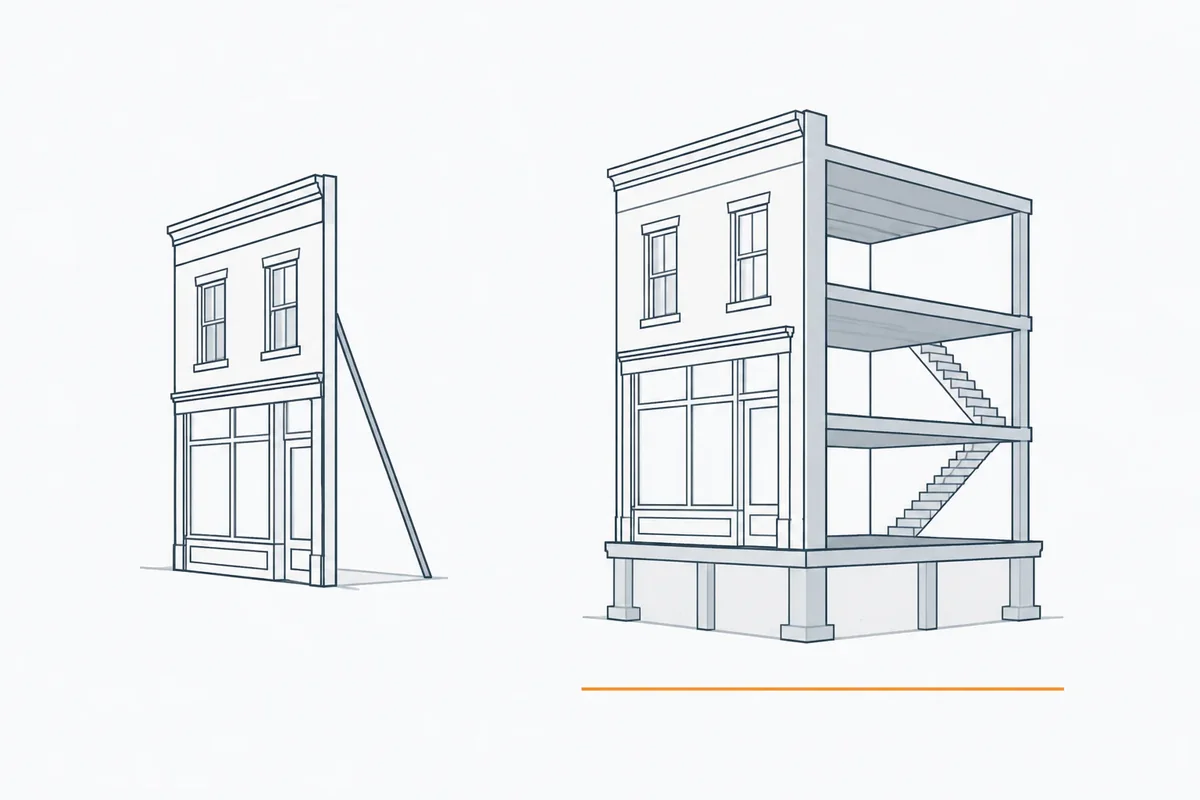
Here's the failure mode we see most often, and it's worth being blunt about.
A listing looks like a SaaS. There's a dashboard, a pricing page, a login. Then you deploy it and find there's no separation between accounts, no billing behind the pricing page, no way for an admin to suspend anyone, and no branding controls that don't involve editing files on the server.
That isn't a platform. It's a demo with a screenshot budget.
Four checks, and you can run all of them inside any honest demo in about ten minutes.
- Tenant isolation. Create a second account. Can it see the first account's data? If yes, walk away. Nothing else on this list matters.
- Real billing. Is there a payment gateway actually wired in, with webhook handling for upgrades, downgrades, and failed payments? A pricing page with no processor behind it is a mockup. Ask which gateways: Stripe is table stakes, and coverage for Paystack, Flutterwave, or Razorpay matters a lot outside the US and EU.
- An admin economy. Can an admin create plans, set what each action costs, change limits, and suspend a user? Without this you cannot control your own margins, because your API spend scales with usage and your revenue doesn't.
- Branding without code. Logo, application name, colours, and emails, all changeable from an admin screen. If it needs a redeploy, every rebrand is a developer ticket.
Here's the admin side of one of ours, so you know what you're looking for:
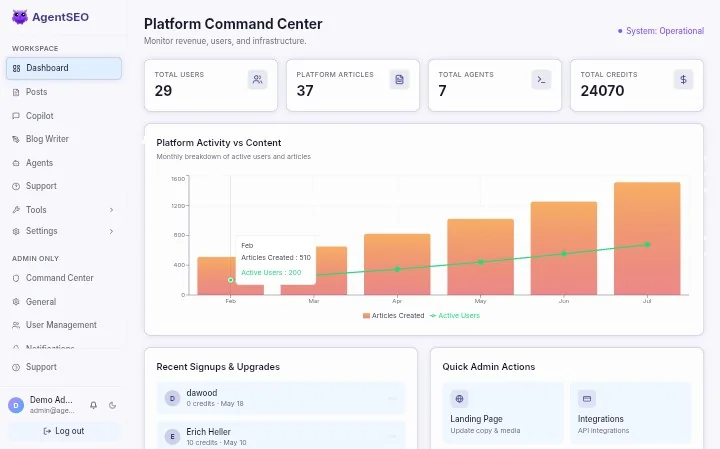
The chart on that screen maps subscription revenue against estimated AI compute cost. That's the number that decides whether a white label SaaS business works, and most listings in this category don't surface it at all.
The Platforms We License
Three, and they're built for different audiences.
PromptRank tracks how ChatGPT, Claude, Gemini, Grok, and Perplexity describe a brand: which prompts mention you, which name a competitor instead, which sources the models cite, and how sentiment shifts over time. It syncs with Google Search Console so tracked prompts come from queries you already convert on. $99 regular, $499 extended.
AgentSEO is a content platform with background agents that research topics, outline, draft section by section, score quality before publishing, and post to WordPress. It includes a WhatsApp and Telegram copilot, a credit economy you control, and four payment gateways. $69 regular, $350 extended.
Keyng Koin is a Telegram tap-to-earn game template on TON, built with Redis caching and queue workers so it holds up past 100k concurrent taps without the database seizing. $49 regular, $299 extended.
All three pass the four checks above, which is not a coincidence. They exist because we got rejected by these marketplaces repeatedly in the early days, and each rejection sent us back to fix the unglamorous parts: authentication, rate limiting, input sanitisation, tenant separation. Three years of building daily, and the approval that finally came through was for the boring work, not the demo.
Getting It Live
The honest friction point in this whole category is deployment.
These platforms run background workers and scheduled jobs, which means they need a Linux VPS. They will not run on cPanel shared hosting, and they will not run on Vercel or Netlify, because serverless functions don't stay alive long enough to process a queue. A 4GB droplet at $24 a month is comfortable for early traffic.
Two routes from there.
Do it yourself. Each platform ships with an installer script that provisions Ubuntu, Node.js, PostgreSQL, Redis, PM2, and Nginx with SSL, then hands you a web setup wizard where you create your admin account and enter API keys. No manual config editing. A comfortable Linux user will be done in an evening.
Have us do it. Our installation plan is a flat $150 and takes 48 hours. Server hardening, database and cache setup, cron configuration, SSL. We hand you a running platform and the credentials.
A buyer came to us last year after three weekends fighting a deployment on the wrong kind of hosting. His workers kept dying silently, so his scheduled jobs looked like they were running and weren't. We moved him to a proper VPS and had him live the next day for $150. Three weekends is worth more than $150 to almost everybody.
Skip the weekends. The VPS Installation Plan is a flat $150, and every other plan we offer is listed publicly beside it.
When Custom Beats Licensing
We sell these platforms, and we'll still tell you when not to buy one.
Our rule is a number. If a platform covers at least 90% of what's in your head, license it and pay for the last 10% as customization. That's the smart money move, and it's most people. If your idea is genuinely unlike anything on the market, custom is the only road.
Our founder learned this the physical way, years back, working on an advert-placement concept for tricycles, Keke as we call them in Nigeria. The idea needed a specific plastic mold and nothing on the market fit the shape in his head. The only way to build it was to make a new mold from scratch.
Software is exactly the same. When nothing fits, you build, and custom gives you something nobody has seen before. When something does fit, buying it and adjusting the last stretch gets you to market months earlier for a fraction of the money.
The Model Explained
If you want the general case for the category before looking at specific products:
Frequently Asked Questions
What is white label SaaS?
Finished software you license once and run under your own brand, on your own server, with your own pricing. Your customers see your name and pay you directly. You own the deployment and the customer relationship, but not the right to resell the code.
How much does white label SaaS cost?
Ours are $49 to $99 for a regular licence and $299 to $499 for an extended licence, paid once. Add $12 to $40 a month for a server and an optional $150 for installation. Building equivalent software from scratch runs $8,000 to $18,000.
Can I charge my customers for white label software?
Only on an extended licence. A regular licence covers an end product that's free to its users. This is the single most expensive detail to get wrong in this category.
Do I need a developer to run it?
Not to run it. Installation is the one technical step, and $150 removes it. You'll want a developer only if you need features the platform doesn't have.
What if I need a feature that isn't there?
Our SaaS Customization Plan handles new features, extra payment gateways, and interface changes on a quoted basis. The change stays in your deployment and you own it.
Can I host white label SaaS on shared hosting?
No. Background workers and scheduled jobs need a persistent process, which shared hosting and serverless platforms both kill. A basic VPS is the requirement.
Where to Start
Open a demo and create two accounts in it. That single test tells you more about a white label SaaS platform than any feature list, because it's the check that separates a real product from a screenshot.
Then decide the licence honestly. If users will pay you, buy the extended one. If you're running it inside your own business, the regular licence is enough and we'd rather you spent the difference on marketing.
Start with our white-label SaaS products, where every platform, licence tier, and price is public. If you want the deployment handled, the installation plan is a flat $150. And if you get in and decide the platform only covers half your idea, tell us, and we'll quote the custom build instead. We'd rather lose the licence sale than have you buy the wrong thing.