What an AI Search Visibility Tool Shows You
An AI search visibility tool shows which prompts name your brand, which name a rival, and what the models cite. Real screens, buying checks, and prices.
An AI search visibility tool shows you which of your category's buying questions cause ChatGPT, Claude, Gemini, Grok, and Perplexity to name your brand, which ones cause them to name a competitor instead, and which websites the models read to decide. It's the answer to "does AI know we exist," measured rather than guessed.
Your rank tracker cannot tell you any of this, and the reason is structural rather than a missing feature.
Here's the part worth knowing before you compare products. Every tool in this category will show you a visibility percentage. The percentage is the least useful number on the screen. What you're actually buying is the list of prompts underneath it and the citation data behind those, so that's what this page shows you.
Key Takeaways
- The useful output is a per-prompt breakdown, not a headline score: which questions name you, which name a rival.
- Rank trackers parse an HTML results page. A generated answer isn't one, so there's nothing for them to parse.
- Check four things before buying: engine coverage, live-search grounding, scheduling, and citation extraction.
- Entity clarity is the signal most tools skip, and it's often why a model won't name you at all.
- PromptRank is $99 to license, $499 with resale rights, self-hosted, and you get the source code.
What the Tool Shows You
Start with the screen you'd actually open every week.
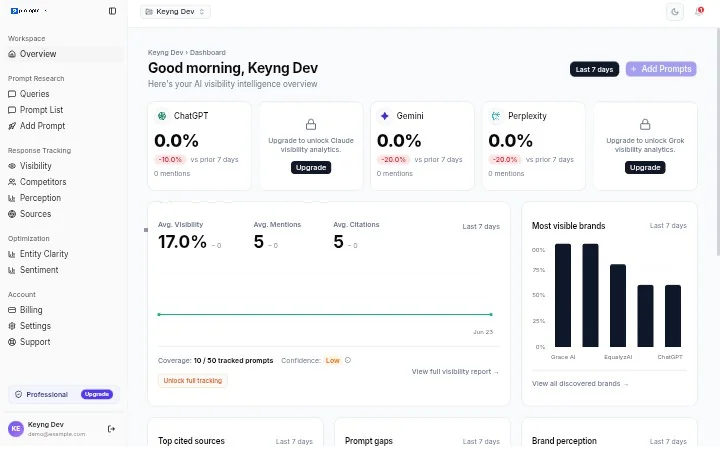
Share of voice at the top, mention trend beside it, the domains being cited, how the models describe you, and which brands are most visible in your category overall. That's the summary layer, and it's the part every product in this space has.
The layer that matters more is the prompt list.
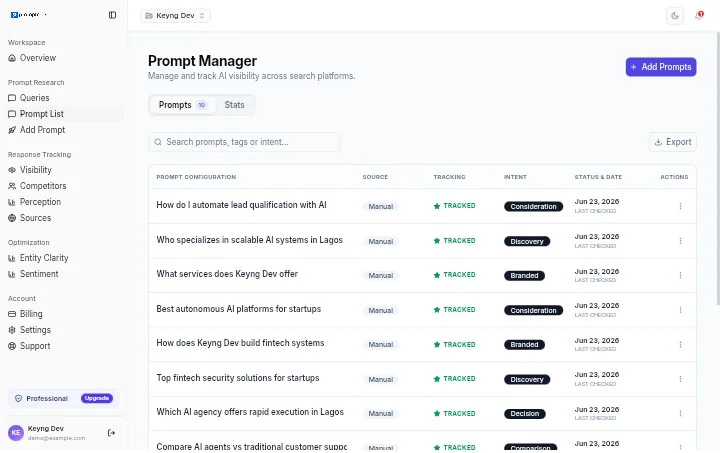
Each row is a real question a buyer types. Each one gets run across five engines on a schedule, and each one resolves to a yes or a no: were you named, or was somebody else. That list is the working surface. A brand at 40% share of voice cares much less about the 40 than about which specific twelve questions are in the missing 60, because those twelve are the work.
Tag them by buying stage, too. Being absent from discovery questions is a marketing problem. Being absent from comparison and decision questions is a revenue problem, and they need different fixes.
Want to see this on your own brand? The PromptRank demo is open and you can run a prompt from your category through it.
Why Rank Tracking Misses This
Not a gap in your tooling. A category error.
A rank tracker fetches a results page, finds your URL in the HTML, and reports its position. Every part of that depends on there being a document with a stable list of links in it.
A generated answer is not a document. It's text produced on demand, differently each time, from a set of sources the model chose in that moment.
There's no position, because there's no list. There's no click-through rate, because the answer often resolves the question without a click. And there's no stable result to re-check tomorrow.
Google's own documentation describes its AI surfaces using a query fan-out technique, issuing multiple related searches across subtopics to assemble one response. So even the input isn't the query you typed. Tracking one keyword's position tells you almost nothing about whether you appear in the answer to it.
You can bolt an AI Overviews column onto a rank tracker, and several vendors have. That's scraping one surface of one engine. It isn't the channel.
Search Console has the same limit and is still worth connecting, for a different reason: the long-tail queries you already convert on are the best possible source for your prompt list. Real buyer phrasing beats a brainstormed list every time.
What to Look For
Four questions. Ask them of every vendor, us included.
| Check | A good answer sounds like | A bad answer sounds like |
|---|---|---|
| Engine coverage | "All five, same cycle, comparable numbers" | "We cover ChatGPT" |
| Live-search grounding | "We fetch search results first, then prompt" | "We query the model directly" |
| Scheduling | "Weekly by default, configurable" | "Run it whenever you like" |
| Citation extraction | "Domains, frequency, and the exact sentence" | "We show mentions" |
How many engines, and how? ChatGPT alone is a fifth of the problem. Ask whether each prompt runs across all the major models in the same cycle, so the numbers are comparable.
Are queries grounded in live search? The most important question and the one almost nobody asks. A tool that just asks the model is measuring training data: months stale, and prone to inventing citations that don't exist. A tool that fetches live search results first and grounds the model in them is measuring what a real user sees today.
Does it run on a schedule? Model answers drift week to week with nothing changed on your side. On-demand runs give you a snapshot. Only a scheduled cycle gives you a trend, and only the trend is actionable. We go into how to read one in our piece on AI visibility tracking.
Does it extract citations? Knowing you were mentioned is worth something. Knowing which four domains the model read to decide that is worth far more, because those pages are where the work actually is. Usually they aren't yours.
One more that most comparisons skip entirely: entity clarity. Models sometimes won't name a brand because they aren't confident they know what it is, especially when the name is a common word or has variants.
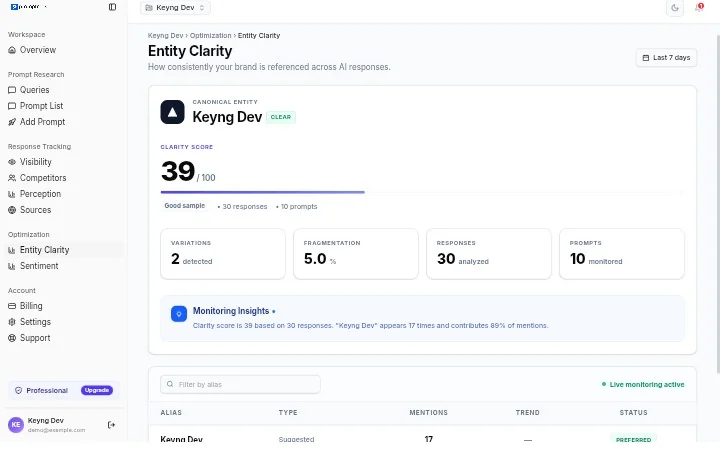
That's a fixable problem, and it's invisible on a share-of-voice chart. If your visibility looks inexplicably low, check this before you rewrite anything.
How PromptRank Measures It
Since we build one of these, here's the mechanism rather than the claim.
You enter your website URL at signup. The system scrapes it, reads the markdown, and extracts your industry, tone, and ideal customer profile, then generates ten starter prompts for your category. You can paste hundreds more, upload a CSV, or import them straight from Search Console through Google OAuth.
Each tracked prompt becomes a background job. A worker fetches live search results first, then runs the same prompt across ChatGPT, Claude, Gemini, Grok, and Perplexity, extracts the exact sentences where a brand is named, records the domains cited, and scores the sentiment and attributes attached to your name. A scheduled job re-runs stale prompts every seven days by default, so the trendline builds without anyone remembering to click anything.
Competitor tracking runs alongside it and surfaces prompt gaps: the questions where a rival was recommended and you weren't. That list is the most directly actionable thing the product produces.
A B2B client of ours came in convinced they were invisible in AI answers. They weren't. They were named in about a fifth of their category's prompts, but the models were attaching a competitor's pricing model to their name, because two heavily cited comparison pages had it wrong.
Three corrected source pages, and the descriptions came right over the following six weeks. No content calendar involved, and no amount of staring at a visibility percentage would have found it. The citation list did.
Ready to see your own citation list? Run the demo against a question your buyers actually ask.
What It Costs to Own
Two shapes in this market, and the difference compounds badly over three years.
Hosted platforms run from roughly $99 to $1,000+ a month depending on tier. At the top end that's $36,000 over three years, and you're renting throughout. If you'd rather see how the hosted options compare on their own terms, we've written that up separately in our comparison of the best AI visibility tools.
PromptRank is $99 for a single deployment, or $499 with resale rights if you're tracking for clients under your own brand. You run it on your own server, so add $12 to $40 a month for a VPS plus the API balances the tracking consumes, which scale with how many prompts you track.
You get the full application: frontend, backend, database schema, admin panel, installer, branding editor. Your logo, your domain, your data. Nobody can reprice you or sunset the product.
Owning your source code gives you flexibility, full stop. It's security, because you decide who touches it. It's freedom, because any developer can change anything.
And if you ever sell the business, it's part of what a buyer is buying. Nobody buys what they can't see.
The honest costs. It needs a Linux VPS, because the background workers and the scheduled cron don't survive on shared hosting or serverless. You fund the model and search API balances yourself. And when something breaks at 2am, it's yours.
If you have no engineer and no appetite for a server, buy a hosted subscription instead. Genuinely. The convenience premium is real value for a team without one, and pretending otherwise would be a bad way to start a relationship. If the server is the only blocker, though, installation is a flat $150 and takes 48 hours.
Skip the setup entirely. The VPS Installation Plan is a flat $150, listed publicly with every other plan.
Google's Own Position
Worth watching before you buy anything in this category, because it undercuts a lot of vendor claims:
Frequently Asked Questions
What is an AI search visibility tool?
Software that runs your category's buying questions through the major AI models on a schedule and records whether your brand was named, who was named instead, which sources the models cited, and how you were described. It measures presence in generated answers rather than position in a results page.
How do I check if ChatGPT mentions my brand?
Ask it your category's buying questions and see. That's genuinely worth an afternoon before you spend anything. It stops working as a method once you need to compare weeks, cover five engines, and avoid unconsciously phrasing prompts in your own favour.
Can Google Search Console show AI visibility?
No. Search Console reports your performance in Google Search, not what a model says in a generated answer. It's still worth connecting to a visibility tool, because your converting long-tail queries make the best prompt list.
How much does an AI search visibility tool cost?
Hosted platforms run roughly $99 to $1,000+ a month. Self-hosted, PromptRank is $99 once or $499 with resale rights, plus $12 to $40 a month for a server and your own API spend.
Which AI engines should it cover?
All the major ones in the same cycle: ChatGPT, Claude, Gemini, Grok, and Perplexity. They answer differently, and the one that matters is whichever your buyers use, which you won't know until you measure all of them.
Why doesn't the model mention my brand at all?
Three common causes: nothing the model trusts says anything specific about you, a competitor owns the pages it does read, or it isn't confident what your brand name refers to. The third is entity clarity, it's fixable, and it's the one most teams never check.
Getting Your First Reading
Take ten questions your buyers genuinely ask, the ones that come up on sales calls, and run them through an AI search visibility tool. Ours or anyone's. Then look at two things and ignore everything else on the screen.
Which prompts named a competitor instead of you. And which domains the models cited to answer them.
That second list is almost never your own website, and it will tell you where the next quarter's work is more clearly than any audit you could commission. It's the single most useful thing this category has taught us, and it's available before you spend anything.
Start with the PromptRank demo, where both licence tiers are listed publicly, if you already know you'd rather own the platform than rent a seat. And if you want it wired into reporting you already run, tell us what you're measuring and we'll come back with a fixed price.
Deploy, get feedback, come back stronger. That works on visibility too: the first reading tells you where you stand, and the third tells you whether anything you did about it worked.