Boutique Custom Software Development Firm Benefits
Learn why hiring a boutique custom software development firm eliminates overhead and delivers bespoke engineering faster than large system integrators.
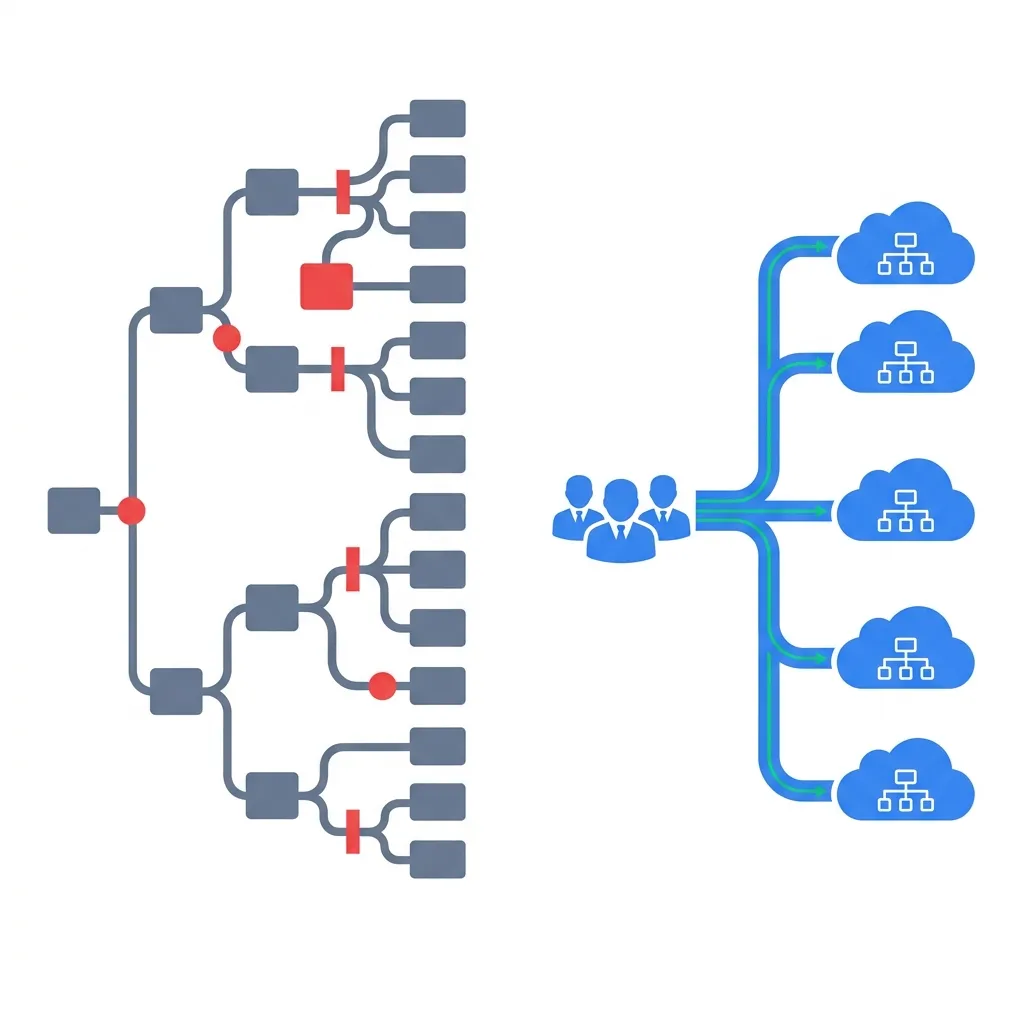
Hiring a custom software development firm should feel like adding senior engineers to your core team.
Most founders find the opposite.
You sign a contract with a 200-person consultancy, and three layers of project managers sit between you and the person writing code. Requirements get distorted at every handoff. Architecture decisions take weeks to approve. Billable hours pile up for status meetings that could have been a two-line message.
We built Keyng Dev as the boutique alternative. Our engineers talk directly with founders, ship production environments in hours, and hand-author every schema, queue, and integration from scratch. No account managers. No template reuse. No proprietary lock-in.
We've shipped 20+ products and handled systems at 100k+ concurrent users — and the reason that's possible with a small team is exactly what this article is about.
Key Takeaways
- Overhead eliminated: Boutique firms cut PM and account-manager layers, reducing billable waste by 40–60%.
- Direct architect access: You speak with the engineer writing your code, not a sales intermediary.
- Bespoke engineering: Every environment, database, and queue configuration is purpose-built — never templated.
- Faster iteration: Lightweight senior teams containerize and deploy in hours, not the weeks typical of large integrators.
Ready to talk scope? Explore our custom development services and see how we structure fast-turnaround engagements.
Why Go Boutique at All
Large consultancies optimize for utilization, not outcomes.
They staff projects with junior developers billed at senior rates, then rotate them every six months to protect margin. Your codebase becomes a training ground for their bench.
Boutique firms invert that model. We deploy a small team of senior engineers who stay on the project from kickoff to production. The person who designs your data architecture is the same person who writes the migrations and reviews the pull requests. There's no translation layer.
Specialization matters because generic solutions fail at the edges. A low-code platform handles basic forms fine, but it breaks the moment you need idempotent background job processing, distributed locking to prevent duplicate transactions, or a custom blockchain wallet handshake. A boutique custom software development services team engineers those pieces from scratch, tuned to your traffic and cost constraints.
Gartner's research on high-performing engineering teams confirms that seniority density — not headcount — drives delivery speed and defect rates. Small, senior teams outperform large, mixed-seniority teams on both axes.
If your team needs senior engineers who ship on day one, that's the core argument right there.
Boutique Versus Large Integrators
The differences compound across every phase of a project.
| Dimension | Boutique Firm | Large Integrator | Low-Code Platform |
|---|---|---|---|
| Team composition | Senior engineers only | Mix of junior, mid, senior | No engineers (configurers) |
| Communication | Direct to architect | PM → account mgr → tech lead → dev | Support tickets |
| Environment setup | Hours | IT ticket queue, 1–2 weeks | Pre-built sandbox |
| Architecture | Bespoke per project | Reusable enterprise templates | Proprietary runtime |
| Hourly cost | $120–$180 | $200–$400 | Subscription + usage fees |
| Code ownership | Full, portable, yours | Full but tangled | Locked to platform |
| Scaling strategy | Custom-tuned per system | Generic auto-scale rules | Platform-defined limits |
Here's a real example of what this looks like in practice.
A fintech founder came to us after a large integrator quoted $180,000 and a 14-week timeline for a ledger system with idempotent payment processing. The project was staffed with two junior developers and a part-time architect.
We shipped the same system in five weeks for $42,000. Our team built idempotent background workers, added distributed locking to prevent double-spending, and wrote a full test suite covering edge-case concurrent transfers. The founder spoke directly with our lead engineer every day. No intermediaries, no status calls.
When you choose a custom software development company, the question isn't just about cost. It's about who touches your code and how fast they can actually move.
Direct Access to Your Engineers
This is the single biggest difference founders report after switching to a boutique firm.
At a large consultancy, your technical conversations pass through a project manager who takes notes, forwards them to a tech lead, who briefs the developer. Every hop introduces translation loss. By the time a requirement reaches the keyboard, it's been paraphrased three times — and the original intent is already gone.
We eliminate that chain entirely.
When you describe a problem to our team, the person listening is the person who implements the solution. If you need a hire nextjs developer-level engineer to explain why your API route is timing out, that conversation happens directly — not through a ticket system.
One healthtech client we worked with had spent eight weeks trying to get a previous vendor to approve a Redis cluster configuration. The request moved through three approval layers, each requiring a dedicated status meeting. The configuration never went live.
We got on a call, reviewed the setup, identified the missing environment variable causing the sentinel failure, and pushed the fix before the call ended. Two days from first message to running cluster.
That's what direct access looks like in practice.
Ready to work with engineers who answer their own Slack messages? Review our custom development services to see how we structure engagements.
How We Iterate So Fast
Speed isn't about working longer hours. It's about removing friction from every decision.
Large integrators have approval processes for everything. Spinning up a database instance requires an infrastructure ticket. Adding a cache layer means a capacity-planning meeting. Changing a network topology triggers a security review that takes five business days.
We move faster because the engineer making the decision is the engineer executing it. On day one of every project, our team deploys a fully containerized, production-parity stack — Postgres, Redis, and background job workers — so every developer on our side is running the same environment as production from hour one.
From there, iteration is genuinely fast. Need to add a read replica? Our engineers edit the environment config and test locally within the hour. Want to benchmark one database query strategy against another? We run it against the same data set production uses — no approximations.
Here's a concrete case. A dental clinic chain we worked with was losing 30% of inbound patient calls during business hours — calls that never got returned and turned into lost bookings. Their previous vendor had spent six weeks in "discovery" without writing a line of code.
We built and deployed an AI receptionist for the clinic in three weeks. It answered patient inquiries, handled appointment booking, and sent calendar confirmations automatically. In the first month, their booking rate rose 22%. When the operations director wanted to add Spanish-language support, she called our lead engineer directly. We shipped the change in four days.
McKinsey's delivery benchmarks show that small, empowered teams make architecture decisions 3–5x faster than matrixed organizations. The bottleneck is never the technology. It's always the org chart.
Custom Engineering vs. Low-Code
Here's the part most founders wrestle with.
Low-code and no-code platforms look appealing at the start. Quick setup, visual workflows, no hiring required. For validating a basic idea, that can genuinely make sense.
The problem shows up once your requirements move past the platform's ceiling — custom payment gateway logic, prioritized background job queues, database-level security policies, or blockchain wallet integrations. At that point, you're not building on the platform anymore. You're fighting it. And the abstraction layer that was meant to help you is now something you have to debug instead of your own business logic.
We don't use proprietary runtimes. Our code runs on your server, in your containers, against your database. When you need to modify a retry strategy or add a middleware layer, our engineers open the file and edit it. No platform permissions, no vendor approval, no abstraction leak.
That's the difference between renting tools and owning software.
The ownership question matters more than most founders realize upfront. Your source code is a sellable asset. It's flexibility when requirements change. It's your leverage when you need to negotiate with a new vendor or raise a round. Nobody buys what they can't see — and platforms don't give you code to show.
FAQ
What does a custom software development firm do?
A custom software development firm designs, builds, and deploys bespoke software tailored to a client's specific requirements. Unlike SaaS vendors or low-code platforms, the firm writes original code and delivers full source ownership to the client.
How much does it cost to hire a boutique firm?
Engagements vary by scope. Our VPS Installation Plan starts at $150 for environment setup. AI automation projects begin at $500. Full-stack SaaS MVPs are custom-quoted based on feature complexity. Large integrators typically start at $50,000+ for comparable work.
Is a boutique firm better than a large consultancy?
For most startups and mid-market companies, yes. Boutique firms offer direct architect access, faster iteration, and senior-only teams at 40–60% lower cost. Large consultancies make sense for enterprises needing multi-region compliance, dedicated security teams, or 50+ developer rosters.
Can a boutique firm scale with my company?
Yes. We architect systems to scale from day one — Postgres read replicas, Redis caching layers, distributed background workers, and container orchestration. The code we write doesn't need a rewrite when you hit 100,000 users. It needs horizontal scaling, which we design for upfront.
The Bottom Line
The case for a boutique custom software development firm comes down to three things: who writes your code, how fast they iterate, and whether you own the result.
Large integrators add overhead at every layer. Low-code platforms add abstraction ceilings. Boutique firms remove both problems by putting senior engineers directly in front of founders — and shipping bespoke systems from day one.
We've delivered 20+ production-grade products across fintech, healthtech, and consumer apps. The founders who come back to us don't come back because we were the cheapest option. They come back because it worked exactly the way they had it in their head.
If you're evaluating engineering partners, review our services page and reach out. We'll get on a call, review your architecture, and tell you exactly what we'd build — and how fast.