Bespoke Custom Software Development Services
Learn how bespoke custom software development services deliver high-performance Next.js MVPs with PostgreSQL, Docker, and Stripe integrations.
Founders waste three months wrestling with no-code platforms that collapse at the first sign of real traffic.
Optimistic database locks fail. Webhook queues back up. The "launch in a weekend" promise turns into a rewrite that eats the entire runway.
Our custom software development services exist to end that cycle. We build production-grade Next.js applications on PostgreSQL, Redis, and Docker — engineered for the exact traffic, compliance, and billing requirements your business demands. No bloated proprietary lock-in. No credit-based pricing traps. Just architecture that scales because it was designed to.
We've shipped 20+ products and handled systems at 100k+ concurrent users — and every one of them started with the same disciplined process we walk through below.
Key Takeaways
- MVP in six weeks: Our Next.js + PostgreSQL stack ships authentication, billing, and API scaffolding on day one.
- Real stack, real ownership: Postgres, Redis, and background job queues — all running in your own containers.
- Post-deployment coverage: Maintenance agreements starting at $150/month keep servers patched and queues healthy.
- Custom over cookie-cutter: Every project starts from your spec sheet, not a template marketplace download.
Explore our custom development services to see how we scope and price fast-turnaround builds.
How We Scope Your MVP
Every engagement starts with a scoping sprint.
We sit down with your team, map the data models, define the API surface, and write the architecture document before a single component gets built. This phase typically runs five to seven business days and produces a concrete technical spec — entity-relationship diagrams, endpoint contracts, and a deployment topology.
That document is not a sales artifact. It's an engineering agreement. You know exactly what's being built before we write a line of code.
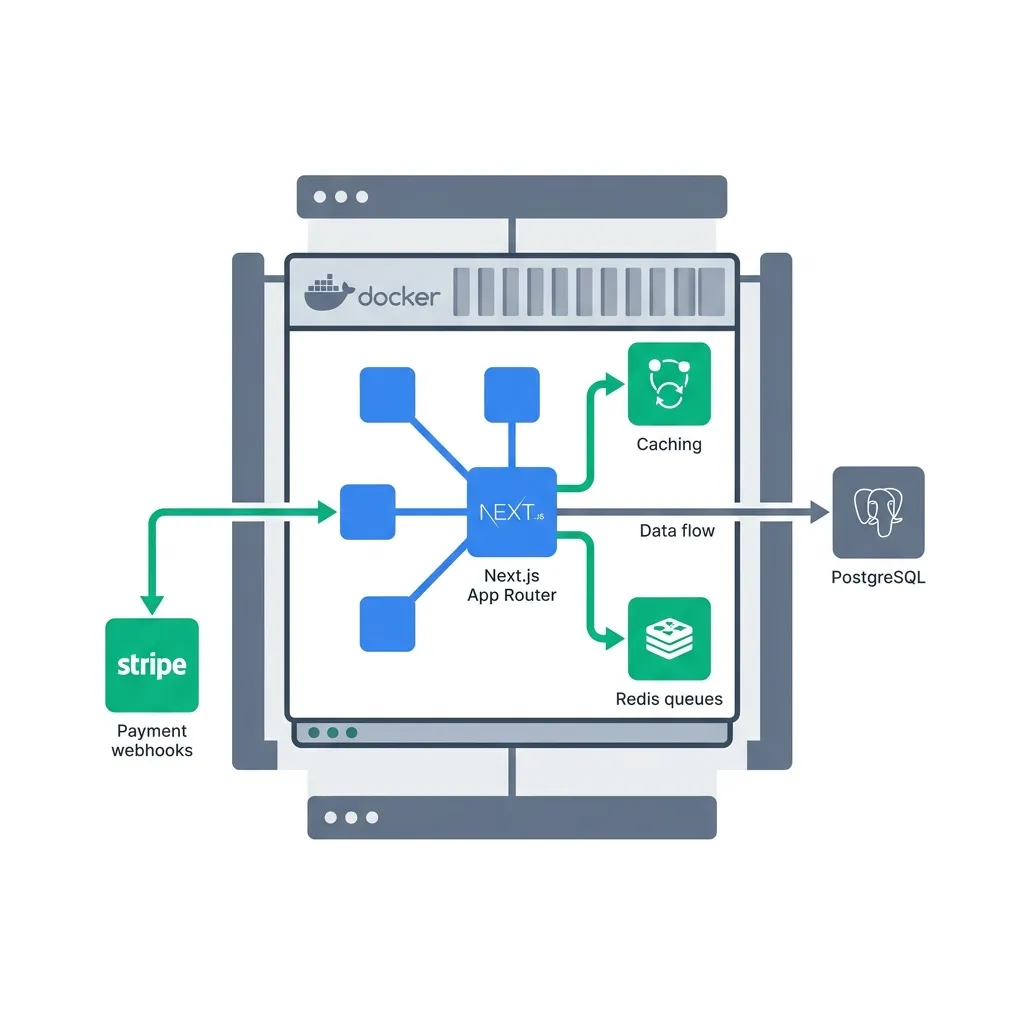
Our stack for every MVP is consistent: Next.js App Router on the frontend, PostgreSQL as the primary data store, Redis for session caching and background job queues, and Docker containers that standardize the environment across local, staging, and production. Here's how those components connect:
This stack runs on a $12/month VPS for early-stage workloads. It scales to multi-instance deployments behind a load balancer without rewriting a single line of application code.
The setup eliminates the first 40 hours of boilerplate on every project — authentication, environment configuration, container networking, health checks — so we're writing business logic from week one.
Here's what that looks like with a real client.
A fintech founder came to us after eight weeks with a freelance team that had delivered a React prototype with no backend, no auth, and no payment integration. We picked up the project in week one of our scoping sprint. By week three, the core reconciliation engine was running on PostgreSQL. By week five, payment webhooks were processing live transactions through background job queues. By week six, the founder demoed the platform to three pilot customers.
The platform handled 14,000 reconciliation events in its first month. Zero queue failures.
Choosing the right custom software development company means choosing engineers who ship code, not slide decks.
Complex Integrations We Build
API integration is where most custom builds stall.
Founders underestimate the complexity of connecting payment gateways, third-party APIs, and AI retrieval pipelines into a single coherent system. Each integration has rate limits, webhook signatures, retry semantics, and failure modes that generic platforms simply ignore.
We build every integration as an isolated service with its own queue, error handling, and monitoring.
Payment Webhook Processing
When a payment event fires — subscription renewal, failed charge, refund — the webhook needs to reach your database reliably even if your server is under load. Most teams handle this synchronously, which means a slow database write can cause a timeout that Stripe interprets as a failure and retries.
We decouple webhook reception from business logic entirely.
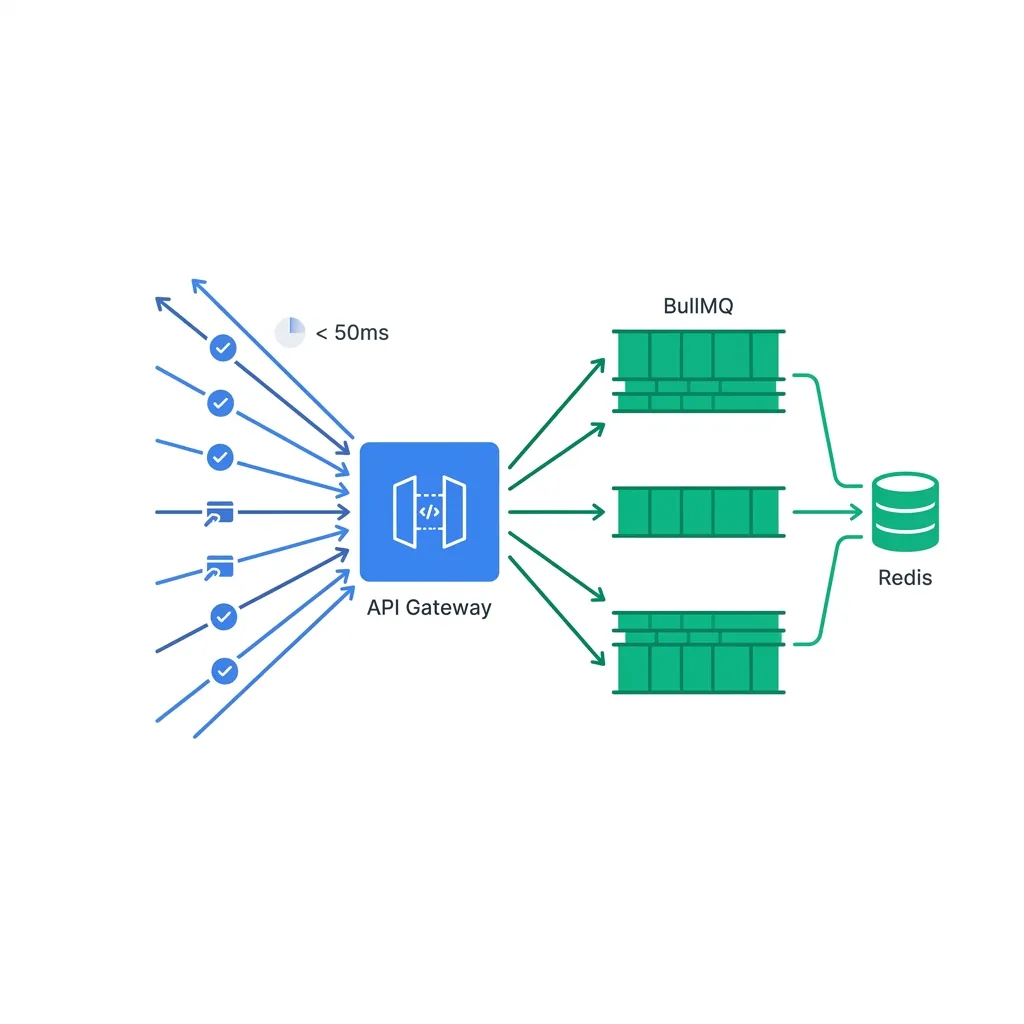
Our pattern across SaaS projects: the webhook endpoint verifies the signature cryptographically and immediately enqueues the event — responding to Stripe in under 50 milliseconds. The actual subscription provisioning, email dispatch, and database updates happen asynchronously in a background worker that retries up to five times on failure with exponential backoff.
The result is a payment pipeline that doesn't drop events under load, doesn't block the webhook endpoint, and recovers automatically from transient failures. The Stripe webhook documentation covers the full event signature verification process if you want the technical detail.
AI-Powered RAG Pipelines
For clients building AI-powered features, we implement retrieval-augmented generation pipelines using PostgreSQL's pgvector extension.
Document chunks are embedded and stored alongside metadata in the same Postgres database as your application data. Query-time retrieval pulls the top-K relevant chunks before sending context to the language model.
This approach keeps retrieval latency under 200 milliseconds for corpora up to 500,000 chunks — and it requires no external vector database. One less dependency, one less failure point.
Working with a custom software development agency that understands RAG architecture means your AI features ship with production-grade retrieval, not a demo-grade wrapper.
How We Migrate Legacy Systems
Legacy systems don't die quietly.
They hold years of business logic in undocumented stored procedures, cron jobs that nobody dares touch, and database schemas that have been patched so many times the original intent is invisible. Migrating them isn't a weekend project — it's an engineering discipline.
We approach every legacy migration in three phases: audit, parallel-run, and cutover.
In Phase 1, we audit the existing system end-to-end. Every endpoint, cron job, and database trigger gets catalogued. We map dependencies and identify the riskiest components before touching a single line.
In Phase 2, we build the new system in parallel. Both old and new systems run simultaneously. We shadow-write to both databases and compare outputs for consistency until confidence is high.
In Phase 3, we execute a controlled cutover with a rollback plan. Traffic shifts incrementally — 10%, 50%, 100% — with automated health checks at each stage.
Here's what this looked like for a regional logistics company running their entire dispatch system on a PHP 5.6 codebase from 2014. The original developer had left. No documentation existed. The system processed 2,300 shipment records daily, and downtime meant delayed deliveries.
We spent two weeks auditing every endpoint and mapping its Next.js replacement. PostgreSQL replaced MySQL, with a schema migration that preserved all foreign key relationships. The parallel-run phase caught three business logic edge cases around multi-stop route calculations that unit tests had missed. We fixed those before cutover.
The new system went live on a Tuesday. Average page load dropped from 4.2 seconds to 380 milliseconds. The dispatch team didn't lose a single shipment record during transition.
That's what a clean migration looks like.
Post-Launch Maintenance Plans
Shipping the MVP is the starting line, not the finish.
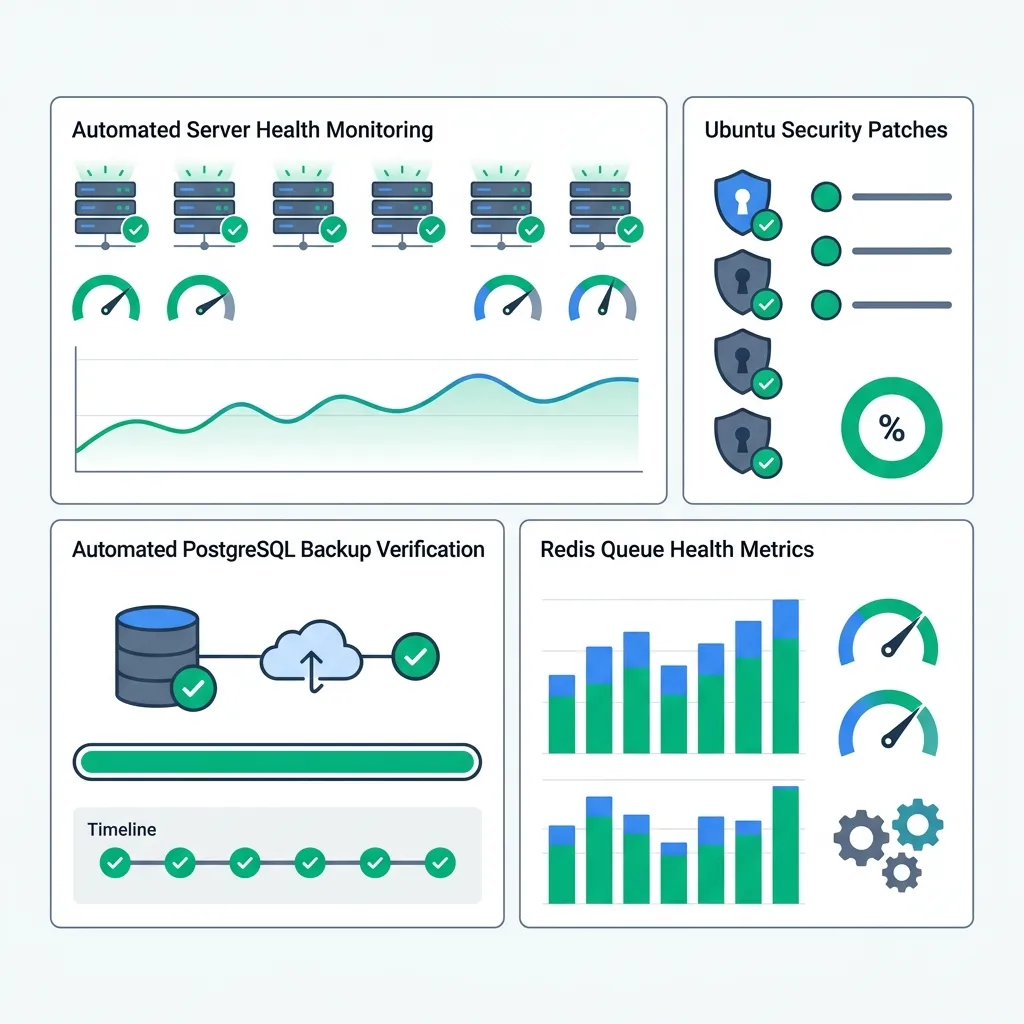
Software degrades. Dependencies publish breaking changes. Postgres vacuum jobs bloat tables. Redis memory grows. SSL certificates expire. Without active maintenance, a production system accumulates technical debt until something critical breaks at 2 AM.
We offer structured maintenance agreements that keep systems healthy from day one.
| Plan | Monthly Cost | Coverage | Response Time |
|---|---|---|---|
| VPS Monitoring | $150 | Server uptime, security patches, Docker updates | 24 hours |
| API Maintenance | $500 | Bug fixes, dependency upgrades, queue monitoring | 8 hours |
| Full-Stack SLA | Custom | Feature development, performance tuning, on-call | 2 hours |
The VPS plan covers Ubuntu security tuning, Docker image updates, PostgreSQL backup verification, and Redis health checks. We run automated cron jobs that test backup restoration monthly — because a backup you've never restored isn't a backup.
The API plan adds dependency auditing, BullMQ queue monitoring, and proactive bug fixes. We track NPM advisories and patch vulnerabilities within 48 hours of disclosure.
The Full-Stack SLA includes feature development hours, performance optimization, and on-call response for production incidents. That's the plan for platforms generating revenue and requiring uptime guarantees.
Partnering with a custom software development firm that offers post-deployment maintenance means your system stays healthy long after the launch celebration.
What Ownership Actually Means
Here's the part most founders realize too late.
No-code platforms and low-code tools look like a shortcut until the day you need something they don't support — custom payment gateway logic, a specific compliance requirement, a background job that runs on your schedule. At that point, you're not building on the platform. You're working around it. And every workaround adds technical debt you don't own.
When we deliver a project, you receive the complete source code, Docker configuration, and deployment scripts. You can host it on any VPS provider. You can hire another team to maintain it. You can modify it, resell it, or build on top of it.
| What You Get | keyngdev | No-Code Platform | Generic Agency |
|---|---|---|---|
| Full source code ownership | Yes | Never | Often partial |
| Runs on your own VPS | Yes | No — hosted only | Depends |
| Custom-built to your spec | Yes | Template-limited | Rarely |
| Post-launch maintenance plans | From $150/month | N/A | Rarely included |
| Direct senior engineer access | Always | N/A | Account manager |
That is what custom means. And that's why "nobody buys what they can't see" — owning your code is owning the asset.
FAQ
What are custom software development services?
Custom software development services cover the full lifecycle of building bespoke software — scoping, architecture, coding, deployment, and maintenance. Unlike SaaS products, the client owns the source code and infrastructure.
How long does a custom MVP take?
Our typical MVP ships in six weeks using the Next.js + PostgreSQL stack. Complex integrations like RAG pipelines or multi-tenant billing can extend the timeline to 10 weeks.
What tech stack do you use?
We standardize on Next.js App Router, PostgreSQL, Redis, Docker, and Stripe. For AI features, we add pgvector for retrieval-augmented generation. Every project deploys on Ubuntu VPS instances.
How much do custom development services cost?
Projects start at $150 for VPS installation and scale to custom quotes for full-stack SaaS MVPs. Maintenance agreements begin at $150/month. We provide fixed-scope pricing after the scoping sprint.
Do you maintain the software after launch?
Yes. We offer three maintenance tiers — VPS monitoring, API maintenance, and full-stack SLA. Each plan covers different levels of monitoring, bug fixes, and response times.
The Bottom Line
Custom software development services should deliver working architecture, not marketing decks.
We ship Next.js applications on PostgreSQL, Redis, and Docker — built to your specifications, owned by your team, and maintained through transparent service agreements. Whether you need a six-week MVP, a legacy system migration, or ongoing maintenance for a revenue-generating platform, our engineering team has the stack experience to execute.
Explore our custom development services to start your scoping sprint, or learn more about what makes a custom software development company the right partner for your next build.